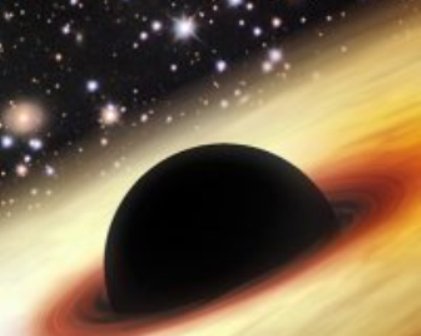

NEW YORK: Contrary to what some physicists have argued for years, information is not lost once it has entered a black hole, scientists, including one of Indian-origin, have claimed.
Many physicists believe black holes suck in information and then evaporate without leaving behind any clues as to what they once contained.
“According to our work, information isn’t lost once it enters a black hole. It doesn’t just disappear,” said Dejan Stojkovic, associate professor of physics at the University at Buffalo (UB).
Stojkovic’s new study with UB PhD student Anshul Saini, as co-author outlines how interactions between particles emitted by a black hole can reveal information about what lies within, such as characteristics of the object that formed the black hole to begin with, and characteristics of the matter and energy drawn inside.
This is an important discovery, Stojkovic said, because physicists who believed information was not lost in black holes have struggled to show, mathematically, how this happens.
The new study presents explicit calculations demonstrating how information is preserved, Stojkovic said.
The research marks a significant step toward solving the “information loss paradox,” a problem that has plagued physics for almost 40 years, since Stephen Hawking first proposed that black holes could radiate energy and evaporate over time.

Tesla driverless system to use updated radar technology
WASHINGTON: Electric carmaker Tesla announced Sunday it was upgrading its Autopilot software to use more advanced radar technology. In a...