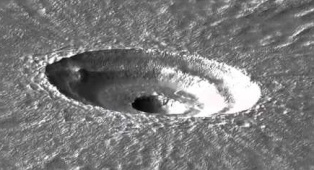

CANADA: Researchers have discovered an enormous slab of ice just beneath the surface of Mars, measuring 130 feet thick and covering an area equivalent to that of California and Texas combined.
The ice may be the result of snowfall tens of millions of years ago on Mars, scientists said.
Combining data gleaned from two powerful instruments aboard NASA’s Mars Reconnaissance Orbiter, or MRO, researchers determined why a “crazy-looking crater” on Mars’ surface is terraced and not bowl shaped, like most craters of this size.
“It’s worth mentioning that terraced craters of this size are quite rare,” said Shane Byrne, associate professor at the University of Arizona’s Lunar and Planetary Laboratory, or LPL.
“But in this area of Mars (Arcadia Planitia), there are a lot of terraced craters. The craters may have formed at different times, but they all have terraces, which indicate something weird is going on in the subsurface,” said Byrne.
Using MRO’s High Resolution Imaging Science Experiment, or HiRISE, camera, the researchers created three-dimensional models of the area’s craters, which allowed them to measure the depth of their terraces.
The researchers then used MRO’s Shallow Radar, or SHARAD, instrument to beam radar pulses to Mars, allowing them to measure the time it took for the radar signals to penetrate the surface’s buried layers and bounce back.
Ali Bramson, a graduate student at LPL, combined the two data sets to measure the radar waves’ speed, a pivotal clue to the layers’ composition. “In this crater’s case, the layers turned out to be ice, and lots of it,” researchers said.
Just beneath Mars’ dirt surface, or regolith, they found an enormous slab of ice, measuring 130 feet thick and covering an area equivalent to that of California and Texas combined.
While the presence of ice came as little surprise to Bramson and Byrne, its age, amount and location did.

Tesla driverless system to use updated radar technology
WASHINGTON: Electric carmaker Tesla announced Sunday it was upgrading its Autopilot software to use more advanced radar technology. In a...