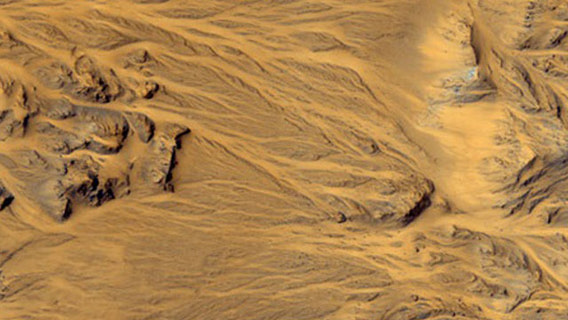

WASHINGTON: The new research from NASA said that wind tunnel exposes the physics that how elements shift in Titan’s methane-laden winds and may help to explain why Titan’s dunes form in which they do not.
“Conditions on Earth seem natural to us, but models from Earth won’t work elsewhere,” said Bruce White, professor of mechanical and aerospace engineering at UC Davis and a co-author on the study. “This paper gives us the thresholds to work out what models for Titan would look like.”
Earth’s dunes are made of silica sand, while Titan’s dunes, revealed by the Cassini space probe, are made of coated grains of crystalline water. Titan’s atmosphere is 95 percent nitrogen, 5 percent methane and about half again as thick as that of Earth.
When a fluid flows over a layer of particles, there is a threshold speed at which the particles start to move. On Earth, air blowing over sand will start to kick up grains when it reaches a wind speed of about 4 meters per second. But flowing water, which is closer in density to silica, will move sand at much lower speeds.
White and colleagues used a wind tunnel in the Planetary Aeolian Laboratory at NASA’s Ames Research Center to establish threshold wind speeds at which grains would start to move on Titan. They found that the threshold was higher than predicted from models based on terrestrial systems.
They were able to reconcile their experiments with the models by allowing for the low ratio of density between particles and atmosphere on Titan.
The new results should help in understanding atmospheric forces on other icy moons and planets with very thin or thick atmospheres, such as Neptune’s moon Triton, Pluto or on comets. They can also help us better understand movement of particles in fluids in general. Particle flows are important in a wide range of situations, including coal-mine or grain-elevator dust explosions, environmental pollution and lubricants.

Tesla driverless system to use updated radar technology
WASHINGTON: Electric carmaker Tesla announced Sunday it was upgrading its Autopilot software to use more advanced radar technology. In a...