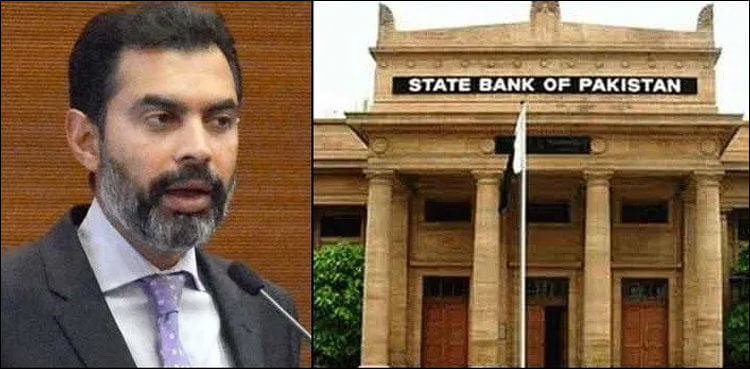
KARACHI: Governor State Bank of Pakistan (SBP) Dr Reza Baqir has said that the draft approved by the Cabinet is a bill and not an ordinance, SBP Autonomy Bill will be presented for discussion in the Parliament. The Governor said that SBP should be given autonomy to pursue its objectives.
Dr. Reza Baqir, in an exclusive interview he said that the country was forced to turn to the International Monetary Fund (IMF). Had it not been for the current account deficit of $19 billion, we would not have gone to the IMF.


Answering a question, he said that an impartial review boosts investor confidence. The IMF review sent the right message of economic direction. If investment increases, unemployment will be eliminated.
He said the government took steps to deal with coronavirus due to better relations with the IMF, which provided $1.4 billion to Pakistan during the pandemic. The SBP launched an employment financing scheme and other initiatives which will continue in the third wave of the pandemic.
“The IMF’s message is to save the economy from the effects of the pandemic, we have to save jobs first,” he said. In South Asia, Pakistan was the first to improve exports and dealt better with the pandemic in its first and second waves.
The SBP Governor said that it is necessary to understand why people are afraid of the IMF. We were compelled to approach the IMF due to faulty policies of the past. However, problems cannot be overlooked after the IMF program. Past governments delayed difficult decisions and took steps detrimental to the economy.
In the past, the exchange rate was not market-based. If the exchange rate were free, the balance of payments would not have been so bad. The Rupee was artificially overvalued and could not be sustained, the subsequent devaluation led to inflation in the country. If the problems are solved in time, the country would not have to go to the IMF, he said.
“Reducing circular debt should be our goal,” he said. We have to repay the circular debt, even if it’s our children who do the repaying. If there was a solution other than raising the price of electricity, everyone would be in agreement.
Answering another important question, Reza Baqir said that our relationship with the IMF had never been cut off and talks were underway during the pandemic as well. Schemes were introduced during the dialogue with IMF. It was decided that they would give loans and we would keep them abreast of our steps. Our policy is that if any IMF recommendation carries weight, we should listen. Once we are able to solve problems on our own, we will not have to go anywhere, he added.
Reza Baqir said that during our relationship with the IMF, the interest rate was almost halved. We explained our future course of action to address the concerns of the public and the monetary policy from two months ago stated that interest rate would not be raised in the near future.
“If we have to raise interest rates in the future, we will increase them gradually. They will not rise as they did when the IMF program began”, he said.
Reza Baqir revealed that Pakistan’s foreign exchange reserves have increased from $7 billion to $13 billion, a rise aimed at boosting investor confidence and unrelated to borrowing. With only $7 billion left in the reserves, tough decisions had to be made, he added.
Talking about the construction sector, he said that in the past, this sector was badly neglected. Steps were taken to increase the role of banks in the affordable housing scheme and loans of Rs 50 billion were given from the very beginning of housing finance. The government also subsidized interest rates and eased conditions for the working class.
Replying to a question on the issue of SBP’s sovereignty, he said that false rumors started circulating as soon as the bill was passed but the draft approved by the cabinet was a bill and not an ordinance. The State Bank Autonomy Bill will be tabled in the parliament and this is not the first time that amendments to the SBP Act will be discussed. The SBP Act will be amended for the sixth time in the last 30 years. The Act was previously amended in 1994, 1997, 2012 and 2015. Changing the Act does not mean that it cannot be changed again and the Parliament has the power to withdraw amendments to the SBP Act. The objectives of the SBP are not written in the body of the present Act. Reducing inflation, ensuring financial stability and economic growth are the objectives of the Bank.
He said that the amendments in the Act were justified to clarify the objectives of the SBP. It should be given the autonomy to pursue its objectives. The purpose of the proposed law is to limit interfere in the operations of the SBP. In turn, the Bank will be asked what it did to achieve its objectives. Accountability would not be possible if the goals remain unclear. Excess currency printing and lending to the government causes inflation. With the amendments to the Act, this will not be allowed to happen.
He said that discipline would have to be exercised to end borrowing. It is easier to ask the SBP to print notes instead of raising taxes. Relying on the SBP does not solve the government’s problems. For a year and a half, the government has not taken any loan from the SBP. A country that repays loans by printing notes witnesses increased inflation.
The SBP governor said that in the past, governments had repeatedly printed excess notes, the effects of which are still seen today. The current inflation is not due to monetary policy, but because of administrative shortcomings. If the government had printed made the State Bank print more money, inflation would have been higher.