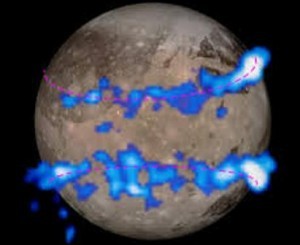

NEW YORK: By using Hubble Space Telescope scientists have discovered evidence for a subsurface ocean on Ganymede—largest moon of Jupiter. The ocean is supposed to carry more water than all water on Earth’s surface.
It is estimated that Ganymede’s ocean is 60 miles thick while 10 times deeper than earth’s oceans. It is buried under a 95 mile thick crust of ice.
“The solar system is now looking like a pretty soggy place,” said Jim Green, director of planetary science at NASA. “The more we look at individual moons, the more we see that water is really in enormous abundance.”
“It’s like a lighthouse,” said Joachim Saur of the University of Cologne in Germany, who led the research. “I was always brainstorming how we could use a telescope in other ways. Is there a way you could use a telescope to look inside a planetary body? Then I thought, the aurorae! Because aurorae are controlled by the magnetic field, if you observe the aurorae in an appropriate way, you learn something about the magnetic field. If you know the magnetic field, then you know something about the moon’s interior.”
Ganymede is the largest moon in our solar system and is the only moon with its own magnetic field. The magnetic field causes aurorae that are ribbons of glowing electrified gas. As it is also affected by Jupiter’s magnetic field, when the latter’s magnetic field changes, the aurorae on Ganymede also change rocking back and forth.
“We ran more than 100 models on supercomputers with different parameters, but every time we got the same result – with no ocean present the aurorae rock by six degrees, if you add an ocean it reduces the rock to two degrees,” Saur said at a news conference Thursday announcing the findings.
“Imagine a magnetically active star with a planet close by, by monitoring the auroral activity on that exoplanet we can infer the presence of water.” said Heidi Hammel, executive vice president of Assn. of Universities for Research in Astronomy.

Tesla driverless system to use updated radar technology
WASHINGTON: Electric carmaker Tesla announced Sunday it was upgrading its Autopilot software to use more advanced radar technology. In a...