Customs Today
  • Home
  • Islamabad
  • Karachi
  • Lahore
  • National
  • Transfers and Postings
  • Chambers & Associations
  • Business
No Result
View All Result
Customs Today
  • Home
  • Islamabad
  • Karachi
  • Lahore
  • National
  • Transfers and Postings
  • Chambers & Associations
  • Business
No Result
View All Result
Customs Today
No Result
View All Result
Home Science & Technology Science

Scientists predict more Earth-like planets in Goldilocks zone

byCustoms Today Report
05/02/2015
in Science, Science & Technology
Share on FacebookShare on Twitter

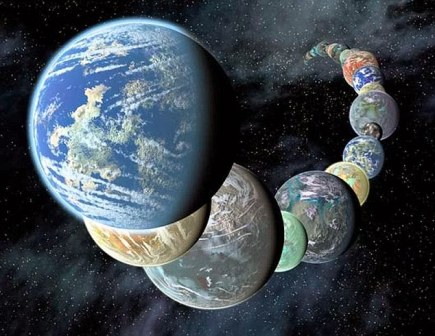
NEW YORK: A team at the Australian National University in Canberra analysed the figures from the Kepler space telescope to predict the number of planets which could be orbiting stars in an area dubbed the “Goldilocks zone”.

These planets are thought to be far enough away from stars for liquid water to survive in the atmosphere to encourage life.


You might also like

Tesla driverless system to use updated radar technology

12/09/2016

Apple to develop its own self-driving technology

10/09/2016

Associate Professor Charley Lineweaver and PhD student Tim Bovaird applied a 200-year-old idea to the thousands of exoplanets spotted in the sky to determine the number of suitable planets.

“We looked at the sub-set of stars that have multiple planets, not just one or two, and among those we looked for specific pattern called the Titius-Bode relation and we found that these exoplanet systems fit the relation better than our solar system does,” he said.

“So based on that we made predictions about where other planets would be if this pattern can be successfully extrapolated beyond what is normally seen.”

The revelation that many more planets than previously thought could contain life sent a shockwave through the astronomy community.

“It’s not just a rare occurrence, and it is not just in our galaxy,” Associate Professor Lineweaver said.

“Essentially our result says almost every single star will have a planet or two in the habitable zone around it.

“The problem is our techniques to detect planets have very strong biases against being able to find planets in the habitable zone and that’s why this new technique, which is really an ancient technique that we have modified, is necessary to make this type of claim.”

Associate Professor Lineweaver stressed these Earth-like planets had not been detected, but his team developed the theory to help identify possible sites.

He said the lack of confirmed signs of life or aliens from other planets could be because it is harder for life to emerge than believed.


Tags: Australian National UniversityEarth-like planetsKepler Space TelescopePossibility of more Earth-like planetsProfessor Charley LineweaverSpace researchTim Bovaird appliedTitius-Bode relation

Related Stories

Tesla driverless system to use updated radar technology

byCT Report
12/09/2016

WASHINGTON: Electric carmaker Tesla announced Sunday it was upgrading its Autopilot software to use more advanced radar technology. In a...

Apple to develop its own self-driving technology

byCT Report
10/09/2016

SAN FRANCISCO: Apple may not become an automaker, but it still wants to develop its own self-driving technology. The iPhone-maker's...

NASA spots slowest known magnetar

byCT Report
10/09/2016

WASHINGTON: Astronomers have found evidence of a magnetar - magnetised neutron star - that spins much slower than the slowest...

‘YouTubers’ outshining old-school television

byCT Report
09/08/2016

SAN FRANCISCO: A media revolution is taking place, and most people over 35 years of age aren’t tuned in. Millennial...

Next Post

20.8% decrease: Qatar’s IQ earns QR6.3bn in 2014

  • Terms and Conditions
  • Disclaimer

© 2011 Customs Today -World's first newspaper on customs. Customs Today.

No Result
View All Result
  • Transfers and Postings
  • Latest News
  • Karachi
  • Islamabad
  • Lahore
  • National
  • Chambers & Associations
  • Business
  • About Us

© 2011 Customs Today -World's first newspaper on customs. Customs Today.