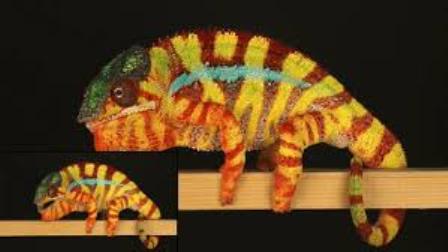

BRENT: The chameleon’s uncanny ability to change color has long mystified people, but now the lizard’s secret is out Chameleons can rapidly change color by adjusting a layer of special cells nestled within their skin, a new study finds.
Unlike other animals that change color, such as the squid and octopus, chameleons do not modify their hues by accumulating or dispersing pigments within their skin cells, the researchers found. Instead, the lizards rely on structural changes that affect how light reflects off their skin, the researchers said.
To investigate how the reptiles change color, researchers studied five adult male, four adult female and four juvenile panther chameleons (Furcifer pardalis), a type of lizard that lives in Madagascar. The scientists found that the chameleons had two superposed thick layers of iridophore cells — iridescent cells that have pigment and reflect light. [See photos of color-changing chameleons]
The iridophore cells contain nanocrystals of different sizes, shapes and organizations, which are key to the chameleons’ dramatic color shifts, the researchers said. The chameleons can change the structural arrangement of the upper cell layer by relaxing or exciting the skin, which leads to a change in color, they found. For instance, a male chameleon might be in a relaxed state when it’s hanging out on a branch, and in an excited state when it sees a rival male.
“When the skin is in the relaxed state, the nanocrystals in the iridophore cells are very close to each other — hence, the cells specifically reflect short wavelengths, such as blue,” said study senior author Michel Milinkovitch, a professor of genetics and evolution at the University of Geneva in Switzerland.

Tesla driverless system to use updated radar technology
WASHINGTON: Electric carmaker Tesla announced Sunday it was upgrading its Autopilot software to use more advanced radar technology. In a...