Customs Today
  • Home
  • Islamabad
  • Karachi
  • Lahore
  • National
  • Transfers and Postings
  • Chambers & Associations
  • Business
No Result
View All Result
Customs Today
  • Home
  • Islamabad
  • Karachi
  • Lahore
  • National
  • Transfers and Postings
  • Chambers & Associations
  • Business
No Result
View All Result
Customs Today
No Result
View All Result
Home Science & Technology Science

Scientists uncovered rare fossil of horned dinosaur

bySana Anwar
05/12/2015
in Science, Science & Technology
Share on FacebookShare on Twitter

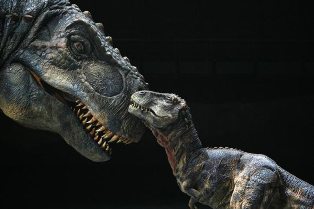
LONDON: Scientists have uncovered the rare fossil of a dog-sized horned dinosaur in eastern North America that roamed the Earth up to 100 million years ago.
The fossil, identified by Dr Nick Longrich from the University of Bath in UK, provides evidence of an east-west divide in North American dinosaur evolution.
During the Late Cretaceous period, 66-100 million years ago, the land mass that is now North America was split in two continents by a shallow sea, the Western Interior Seaway, which ran from the Gulf of Mexico to the Arctic Ocean.
Dinosaurs living in the western continent, called Laramidia, were similar to those found in Asia.
However, few fossils of animals from the eastern ‘lost continent’ of Appalachia have been found because these areas being densely vegetated, making it difficult to discover and excavate fossils.
Longrich studied one of these rare fossils, a fragment of a jaw bone kept in the Peabody Museum at Yale University in US. It turned out to be a member of the horned dinosaurs – the Ceratopsia.

His study highlights it as the first fossil from a ceratopsian dinosaur identified from this period of eastern North America.
Ceratopsia is a group of plant-eating horned dinosaurs that lived in the Cretaceous period. The fossil in question comes from a smaller cousin of the better known Triceratops, the leptoceratopsids. It was about the size of a large dog.
The specimen studied by Longrich was too incomplete to identify the exact species accurately, but showed a strange twist to the jaw, causing the teeth to curve downward and outwards in a beak shape.
The jaw was also more slender than that of Ceratopsia found in western North America, suggesting that these dinosaurs had a different diet to their western relatives, and had evolved along a distinct evolutionary path.


You might also like

Tesla driverless system to use updated radar technology

12/09/2016

Apple to develop its own self-driving technology

10/09/2016

Related Stories

Tesla driverless system to use updated radar technology

byCT Report
12/09/2016

WASHINGTON: Electric carmaker Tesla announced Sunday it was upgrading its Autopilot software to use more advanced radar technology. In a...

Apple to develop its own self-driving technology

byCT Report
10/09/2016

SAN FRANCISCO: Apple may not become an automaker, but it still wants to develop its own self-driving technology. The iPhone-maker's...

NASA spots slowest known magnetar

byCT Report
10/09/2016

WASHINGTON: Astronomers have found evidence of a magnetar - magnetised neutron star - that spins much slower than the slowest...

‘YouTubers’ outshining old-school television

byCT Report
09/08/2016

SAN FRANCISCO: A media revolution is taking place, and most people over 35 years of age aren’t tuned in. Millennial...

Next Post

Zimbabwe Econet global obtains $500mln Chinese loan facility

  • Terms and Conditions
  • Disclaimer

© 2011 Customs Today -World's first newspaper on customs. Customs Today.

No Result
View All Result
  • Transfers and Postings
  • Latest News
  • Karachi
  • Islamabad
  • Lahore
  • National
  • Chambers & Associations
  • Business
  • About Us

© 2011 Customs Today -World's first newspaper on customs. Customs Today.