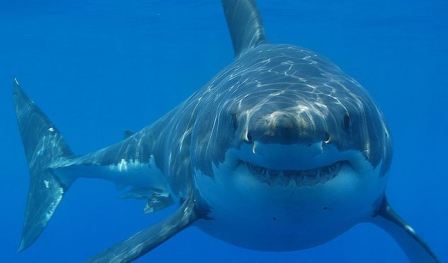

HONG KONG: At least that’s the premise behind the “mistaken identity” theory that tries to explain why sharks sometimes attack people.
While the idea seems reasonable, even logical, it has never been tested until now.
At Sydney’s Taronga Zoo, researchers have this month run a series of experiments to understand what drives a shark to attack by mimicking what they see and hear underwater.
With this information, they hope to develop specific shark repellents, such as making surfboards less attractive with lights; a feature they’ll test on South Africa’s white pointer population later this year.
“We know their visual system isn’t as good as ours,” said lead researcher Nathan Hart, a neuroscientist at the University of Western Australia.
Sharks are colour blind but they have very sensitive eyes, making them good at detecting objects in low contrast. However, they also have poor spatial acuity, which essentially means their vision is more blurred than humans.
“If you now imagine blurring those images, you can see how there’d be even more similarity between them because the details of the arms and the legs get hidden,” Dr Hart said.
“You can see quite easily how that mistaken identity might come about,” he said.
To simulate what sharks might see and hear underwater, the team recorded Taronga Zoo’s seals and sea lions – shark’s natural prey – swimming and splashing using underwater cameras and hydrophones.

Tesla driverless system to use updated radar technology
WASHINGTON: Electric carmaker Tesla announced Sunday it was upgrading its Autopilot software to use more advanced radar technology. In a...