
Customs Today
  • Home
  • Islamabad
  • Karachi
  • Lahore
  • National
  • Transfers and Postings
  • Chambers & Associations
  • Business
No Result
View All Result
Customs Today
  • Home
  • Islamabad
  • Karachi
  • Lahore
  • National
  • Transfers and Postings
  • Chambers & Associations
  • Business
No Result
View All Result
Customs Today
No Result
View All Result
Home Science & Technology Science

Space probe Dawn reaches Ceres, becoming first spacecraft to orbit dwarf planet

byCustoms Today Report
10/03/2015
in Science, Science & Technology
Share on FacebookShare on Twitter

You might also like

Tesla driverless system to use updated radar technology

12/09/2016

Apple to develop its own self-driving technology

10/09/2016

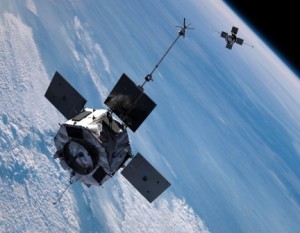
NEW YORK: Space probe Dawn has successfully slipped into orbit around Ceres, becoming the first spacecraft to orbit a dwarf planet. “We feel exhilarated,” says lead researcher Chris Russell at the University of California, Los Angeles, in a statement after Dawn radioed back to Earth on March 6.
Located just beyond Mars, Ceres is believed to be a leftover from the formation of the solar system. It’s the second stop on Dawn’s mission to study two of the biggest non-planetary objects in the inner Solar System. Dawn has already completed its 14-month tour of the asteroid Vesta, the largest body in the asteroid belt between Mars and Jupiter.
The probe will now spend about a month re-positioning itself from its initial orbit about 61,000km above Ceres to the first survey altitude of 4,400 km. After that, it will study the dwarf planet for 16 months, descending to as low as 375km above Ceres’ surface to carry out its survey.
Launched in 2007 and costing NASA about US$473mil (RM1.7bil), Dawn is NASA’s first mission to include stops at more than one extraterrestrial body. In order to do that, Dawn has an ion electric propulsion engine, which requires far less fuel than traditional chemical engines.
Scientists had initially planned for Dawn to fly by Pallas, another dwarf planet, after its stay with Ceres. However, issues with some of Dawn’s onboard equipment have made it impossible, which also means that the probe will be left in perpetual orbit around Ceres after completing its mission in June 2016.

Tags: becoming first spacecraftChris Russelldawn reaches CeresLOS ANGELESorbit dwarf planetSpace probe DawnUniversity of California

Related Stories

Tesla driverless system to use updated radar technology

byCT Report
12/09/2016

WASHINGTON: Electric carmaker Tesla announced Sunday it was upgrading its Autopilot software to use more advanced radar technology. In a...


Apple to develop its own self-driving technology

byCT Report
10/09/2016

SAN FRANCISCO: Apple may not become an automaker, but it still wants to develop its own self-driving technology. The iPhone-maker's...

NASA spots slowest known magnetar

byCT Report
10/09/2016

WASHINGTON: Astronomers have found evidence of a magnetar - magnetised neutron star - that spins much slower than the slowest...

‘YouTubers’ outshining old-school television

byCT Report
09/08/2016

SAN FRANCISCO: A media revolution is taking place, and most people over 35 years of age aren’t tuned in. Millennial...

Next Post

US stocks higher at end, Dow Jones jumps 138.94pts

  • Terms and Conditions
  • Disclaimer

© 2011 Customs Today -World's first newspaper on customs. Customs Today.

No Result
View All Result
  • Transfers and Postings
  • Latest News
  • Karachi
  • Islamabad
  • Lahore
  • National
  • Chambers & Associations
  • Business
  • About Us

© 2011 Customs Today -World's first newspaper on customs. Customs Today.