
Customs Today
  • Home
  • Islamabad
  • Karachi
  • Lahore
  • National
  • Transfers and Postings
  • Chambers & Associations
  • Business
No Result
View All Result
Customs Today
  • Home
  • Islamabad
  • Karachi
  • Lahore
  • National
  • Transfers and Postings
  • Chambers & Associations
  • Business
No Result
View All Result
Customs Today
No Result
View All Result
Home Science & Technology Science

Space probe launches to study mystery of Northern lights

byCustoms Today Report
29/01/2015
in Science, Science & Technology
Share on FacebookShare on Twitter

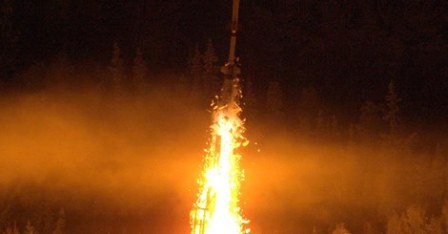
LONDON: Utah State University along with NASA has successfully started a probe into the mystery of northern lights.

The Aurora Spatial Structures Probe (ASSP) was launched at around 5:41 a.m. ET from Poker Flat Research Range close to Fairbanks, Alaska that had been carrying payloads into the Aurora Borealis.


You might also like

Tesla driverless system to use updated radar technology

12/09/2016

Apple to develop its own self-driving technology

10/09/2016

Professor Charles Swenson is the director for the Center for Space Engineering at Utah State and also is the principal investigator for the ASSP mission. He said, “The successful launch of the Auroral Spatial Structures Probe will enable scientists and satellite operators to better understand the energy processes during auroral activity in the thermosphere and its effects on satellites as they orbit Earth. Solar winds produce electric currents in the upper atmosphere where auroral activity occurs, and those currents produce heat that can expand the thermosphere which increases the drag on satellites significantly.”

A large central measuring instrument was launched by the ASSP mission. Six small probes were also ejected from the main instrument in midflight. Each of the small probes has diameter of six inches while it weighs around seven pounds.

Tim Neilsen, ASSP program manager at the Space Dynamics Laboratory (SDL) that is a unit of the Utah State University Research Foundation said, “They are ejected from the rocket in different directions at high velocity, essentially acting as space buoys, to create a network of measurements that will allow us to see the structure of the aurora over a much wider area than was possible before.”

Scientists desire to have more knowledge about the Aurora Borealis. Around four NASA soundings rockets were launched near Fairbanks into the northern lights. They made the effort to better understand as well as visualize turbulent air currents in the upper levels of atmosphere.


Tags: Aurora Spatial Structures ProbePoker Flat Research RangeSpace probe launchedstudy Northern lightsUtah State University

Related Stories

Tesla driverless system to use updated radar technology

byCT Report
12/09/2016

WASHINGTON: Electric carmaker Tesla announced Sunday it was upgrading its Autopilot software to use more advanced radar technology. In a...

Apple to develop its own self-driving technology

byCT Report
10/09/2016

SAN FRANCISCO: Apple may not become an automaker, but it still wants to develop its own self-driving technology. The iPhone-maker's...

NASA spots slowest known magnetar

byCT Report
10/09/2016

WASHINGTON: Astronomers have found evidence of a magnetar - magnetised neutron star - that spins much slower than the slowest...

‘YouTubers’ outshining old-school television

byCT Report
09/08/2016

SAN FRANCISCO: A media revolution is taking place, and most people over 35 years of age aren’t tuned in. Millennial...

Next Post

Qatar’s QIC profits rise to over QR1bn in 2014

  • Terms and Conditions
  • Disclaimer

© 2011 Customs Today -World's first newspaper on customs. Customs Today.

No Result
View All Result
  • Transfers and Postings
  • Latest News
  • Karachi
  • Islamabad
  • Lahore
  • National
  • Chambers & Associations
  • Business
  • About Us

© 2011 Customs Today -World's first newspaper on customs. Customs Today.