NEW YORK: The private spaceflight company SpaceX will attempt the ultimate space double-header with the launch of a space weather observatory followed by an ambitious rocket landing attempt on a floating platform in the Atlantic Ocean.
Former Vice President Al Gore, who first envisioned the observatory two decades ago, was on hand for the attempt.The SpaceX company halted the countdown at the 2½-minute mark following the loss of the Air Force radar system for tracking the rocket in flight. Chief executive officer Elon Musk said via Twitter that the company would try again Monday and that the delay probably was for the best.


“Will give us time to replace 1st stage video transmitter,” the company’s billionaire founder wrote, adding that it was not needed for launch, “but nice to have.”
Besides launching its first deep space mission — an observatory that will shoot to a spot 1 million miles (1.6 million kilometers) from Earth to monitor solar outbursts — SpaceX will attempt its second landing of a leftover booster on an ocean platform. It’s part of the company’s plan to eventually reuse rockets.
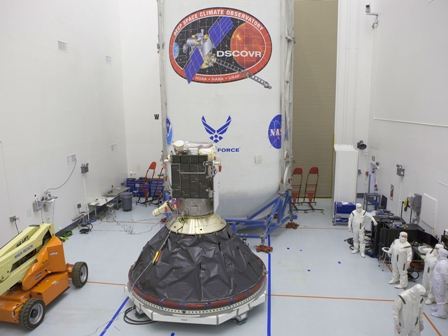
The Deep Space Climate Observatory is refashioned from the Earth-observing satellite conceived in the late 1990s by Gore when he was vice president. It was canceled before ever flying and packed away until several years ago, when NASA, the National Oceanic and Atmospheric Administration and Air Force decided to resurrect it as a space weather sentinel.
Gore arrived at Cape Canaveral well in advance of the sunset liftoff, eager to see his brainchild finally soar. He told reporters an hour before the planned launch time that he was grateful to the scientists and others who kept his dream alive. The measurements will help measure global warming, he noted, and the steady stream of pictures of Earth may help mobilize the public to put pressure on the world’s government leaders “to take action to save the future of human civilization.”
“The constant ability to see the Earth whole, fully sunlit, every single day … can add to our way of thinking about our relationship to the Earth,” said Gore. He was accompanied by Sen. Bill Nelson of Florida, who flew on the space shuttle as a congressman in 1986.
The $340 million mission is meant to provide a heads-up on intense solar activity that can disrupt communications, power and air travel. That’s why the spacecraft is to be stationed 1 million miles (1.6 million kilometers) from Earth and 92 million miles (148 million kilometers) from the sun, the so-called Lagrange point where the gravity fields are neutralized.