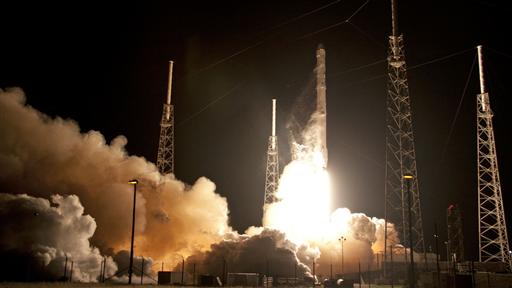

FRANCE: Entrepreneur Elon Musk’s Space Exploration Technology (SpaceX) executed a flawless, predawn launch over the weekend of an unmanned cargo capsule headed for the international space station, but technical troubles spoiled a historic bid to land part of its used rocket booster on a floating platform.
After a Falcon 9 rocket blasted off from Florida’s Cape Canaveral Air Force Station on Saturday and placed the Dragon spacecraft into orbit, the plan was to retrieve the rocket’s 14-story first stage by slowing its descent and having it gently touch down vertically on a converted barge off the Florida coast.
But the return was spoiled when hydraulically controlled fins-deployed on the outside of the booster to help control it-failed to prevent the booster from landing hard and breaking apart. The return system “worked extremely well” at high speed, according to tweets from Mr Musk, SpaceX’s chairman and chief executive, but it “ran out of hydraulic fluid right before landing.”
Mr. Musk also tweeted that “some of the support equipment on the deck will need to be replaced,” but predicted another landing attempt after a February launch.
Saturday’s launch was closely watched by industry and space aficionados because developing a reusable rocket has been a longstanding goal of the global aerospace industry. The latest effort by closely held SpaceX, as the company is known, was the most ambitious experiment so far to show progress toward a commercially viable solution.
In typical rocket launches, parts of the booster either burn up during re-entry or come back too damaged to be reused. SpaceX in the past managed to return a first-stage booster intact, but it toppled over and was damaged after touching down.
This time, SpaceX engineers and executives had hoped to show that the company had improved guidance, propulsion and other technologies to avoid past stumbles.
It wasn’t immediately clear how hard the returning booster smacked down, though in another tweet Mr Musk said sea conditions were dark and foggy, and the company didn’t get a good video of the impact.
Before the launch, Mr Musk pegged chances of success only around 50 per cent.

Tesla driverless system to use updated radar technology
WASHINGTON: Electric carmaker Tesla announced Sunday it was upgrading its Autopilot software to use more advanced radar technology. In a...