Customs Today
  • Home
  • Islamabad
  • Karachi
  • Lahore
  • National
  • Transfers and Postings
  • Chambers & Associations
  • Business
No Result
View All Result
Customs Today
  • Home
  • Islamabad
  • Karachi
  • Lahore
  • National
  • Transfers and Postings
  • Chambers & Associations
  • Business
No Result
View All Result
Customs Today
No Result
View All Result
Home Science & Technology Science

SpaceX’s DSCOVR launch forced to scrub launch due to radar tracking problem

byCustoms Today Report
09/02/2015
in Science, Science & Technology
Share on FacebookShare on Twitter

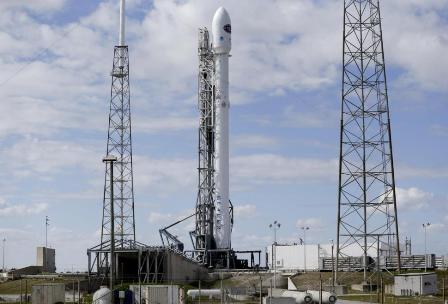
FRANCE: SpaceX’s planned launch of the Deep Space Climate Observatory, or DSCOVR, was postponed until Monday at the earliest due to a problem with the AirForce’s tracking radar system in Florida.

“Hold, hold, hold,” came the call from the launch team, with just two minutes and 26 seconds left in Sunday’s countdown toward a sunset launch.


You might also like

Tesla driverless system to use updated radar technology

12/09/2016

Apple to develop its own self-driving technology

10/09/2016

The team was investigating the radar issue and would confirm a new launch time once the issue was resolved. The next opportunity comes at 6:07 p.m.

We’ll circle back and try to get this mission off of the pad tomorrow.” SpaceX was forced to delay the launch of a Falcon 9 v1.1 rocket with NOAA and NASA’s DSCOVR mission.

SpaceX founder Elon Musk said the launch team was also dealing with a problem that affected a transmitter on the rocket’s first stage.

The delay means the 17-year-long saga leading up to DSCOVR’s launch from Cape Canaveral Air Force Station in Florida would last at least a day longer.

The $340 million mission was first suggested in 1998 by then-Vice President Al Gore, as a way to provide real-time views of Earth’s full sunlit disk from a stable gravitational point a million miles away, known as L1.

The mission ran into resistance in Congress, however, and the spacecraft was put into storage after President George W. Bush came into office.

Several years ago, NASA, NOAA and the U.S. Air Force got together to formulate a new mission that made use of the old satellite: providing early warnings for potentially hazardous solar outbursts.


Tags: Cape Canaveral Air Force Station in FloridaDeep Space Climate ObservatoryNOAA and NASA’s DSCOVR missionSpaceX's DSCOVRSpaceX's DSCOVR forced to scrub launchtracking problem

Related Stories

Tesla driverless system to use updated radar technology

byCT Report
12/09/2016

WASHINGTON: Electric carmaker Tesla announced Sunday it was upgrading its Autopilot software to use more advanced radar technology. In a...

Apple to develop its own self-driving technology

byCT Report
10/09/2016

SAN FRANCISCO: Apple may not become an automaker, but it still wants to develop its own self-driving technology. The iPhone-maker's...

NASA spots slowest known magnetar

byCT Report
10/09/2016

WASHINGTON: Astronomers have found evidence of a magnetar - magnetised neutron star - that spins much slower than the slowest...

‘YouTubers’ outshining old-school television

byCT Report
09/08/2016

SAN FRANCISCO: A media revolution is taking place, and most people over 35 years of age aren’t tuned in. Millennial...

Next Post

Malaysian Authorities steps up crackdown on oil smugglers, 4,700kg oil seized

  • Terms and Conditions
  • Disclaimer

© 2011 Customs Today -World's first newspaper on customs. Customs Today.

No Result
View All Result
  • Transfers and Postings
  • Latest News
  • Karachi
  • Islamabad
  • Lahore
  • National
  • Chambers & Associations
  • Business
  • About Us

© 2011 Customs Today -World's first newspaper on customs. Customs Today.