
Customs Today
  • Home
  • Islamabad
  • Karachi
  • Lahore
  • National
  • Transfers and Postings
  • Chambers & Associations
  • Business
No Result
View All Result
Customs Today
  • Home
  • Islamabad
  • Karachi
  • Lahore
  • National
  • Transfers and Postings
  • Chambers & Associations
  • Business
No Result
View All Result
Customs Today
No Result
View All Result
Home Science & Technology Science

Stanford University develops tiny robots that can pull objects up to 2,000 times their own weight

byCustoms Today Report
29/04/2015
in Science, Science & Technology
Share on FacebookShare on Twitter

You might also like

Tesla driverless system to use updated radar technology

12/09/2016

Apple to develop its own self-driving technology

10/09/2016

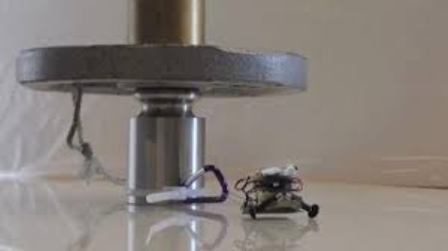
NEW YORK: Tiny robots that can pull objects up to 2,000 times their own weight have been developed at Stanford University.
The miniature robots – dubbed MicroTugs – have power equivalent to a human dragging a blue whale, according to the website detailing the development.
The scientists behind the MicroTugs took inspiration from nature, borrowing techniques used by geckos and ants in their design.
The robots could be used in factories or on building sites.
The team at Stanford, including PhD students David Christensen and Elliot Hawkes, demonstrated a 9g robot that can carry more than 1kg vertically up glass. This is equivalent to a human climbing a skyscraper while carrying an elephant.
Another one – that weighs just 20mg but can carry 500mg, was so tiny it had to be built under a microscope, using tweezers to put the parts together.
The secret to the robots’ strength lies in their sticky feet – which is copied from geckos, some of nature’s most adept climbers.
“The hardest part in the development of these guys was coming to the realization that this was possible,” Mr Christensen told the BBC.
He had worked on making things with the adhesive before but had not considered combining it with robotics.
“When we stepped back and thought about it, this was actually a really great use for our adhesives, with its tiny contact force required, and ability to engage and disengage many times a second,” he said.

Tags: 000 times their own weightMr Christensenrobots that can pull objects up to 2Stanford UniversityStanford University develops tiny robots

Related Stories

Tesla driverless system to use updated radar technology

byCT Report
12/09/2016

WASHINGTON: Electric carmaker Tesla announced Sunday it was upgrading its Autopilot software to use more advanced radar technology. In a...

Apple to develop its own self-driving technology

byCT Report
10/09/2016

SAN FRANCISCO: Apple may not become an automaker, but it still wants to develop its own self-driving technology. The iPhone-maker's...

NASA spots slowest known magnetar

byCT Report
10/09/2016

WASHINGTON: Astronomers have found evidence of a magnetar - magnetised neutron star - that spins much slower than the slowest...

‘YouTubers’ outshining old-school television

byCT Report
09/08/2016

SAN FRANCISCO: A media revolution is taking place, and most people over 35 years of age aren’t tuned in. Millennial...

Next Post

Australian stocks fall by break; S&P 200 descends 69.7pts

  • Terms and Conditions
  • Disclaimer

© 2011 Customs Today -World's first newspaper on customs. Customs Today.

No Result
View All Result
  • Transfers and Postings
  • Latest News
  • Karachi
  • Islamabad
  • Lahore
  • National
  • Chambers & Associations
  • Business
  • About Us

© 2011 Customs Today -World's first newspaper on customs. Customs Today.