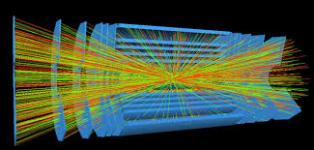


EUROPE: The Standard Model of particle physics, which explains most of the known behaviors and interactions of fundamental subatomic particles, has held up remarkably well over several decades. This far-reaching theory does have a few shortcomings, however—most notably that it doesn’t account for gravity. In hopes of revealing new, non-standard particles and forces, physicists have been on the hunt for conditions and behaviors that directly violate the Standard Model.
Now, a team of physicists working at CERN’s Large Hadron Collider (LHC) has found new hints of particles—leptons, to be more precise—being treated in strange ways not predicted by the Standard Model. The discovery, scheduled for publication in the September 4, 2015 issue of the journal Physical Review Letters, could prove to be a significant lead in the search for non-standard phenomena.
The team, which includes physicists from the University of Maryland who made key contributions to the study, analyzed data collected by the LHCb detector during the first run of the LHC in 2011-12. The researchers looked at B meson decays, processes that produce lighter particles, including two types of leptons: the tau lepton and the muon. Unlike their stable lepton cousin, the electron, tau leptons and muons are highly unstable and quickly decay within a fraction of a second.
According to a Standard Model concept called “lepton universality,” which assumes that leptons are treated equally by all fundamental forces, the decay to the tau lepton and the muon should both happen at the same rate, once corrected for their mass difference. However, the team found a small, but notable, difference in the predicted rates of decay, suggesting that as-yet undiscovered forces or particles could be interfering in the process.

Pakistan to get $3b loan from Islamic Trade Financing Corporation
ISLAMABAD: Islamic Trade Financing Corporation (ITFC) to provide Pakistan with a $3 billion loan, according to an official statement released...