Customs Today
  • Home
  • Islamabad
  • Karachi
  • Lahore
  • National
  • Transfers and Postings
  • Chambers & Associations
  • Business
No Result
View All Result
Customs Today
  • Home
  • Islamabad
  • Karachi
  • Lahore
  • National
  • Transfers and Postings
  • Chambers & Associations
  • Business
No Result
View All Result
Customs Today
No Result
View All Result
Home Science & Technology Science

Sun superflares may disrupt life on Earth

bySana Anwar
04/12/2015
in Science, Science & Technology
Share on FacebookShare on Twitter

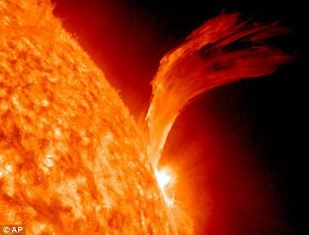
WASHINGTON: Astronomers have seen for the first time how solar flares act as powerful accelerators flinging radiation and particles deep into space at close to the speed of light in a matter of seconds.

The new observations, reported in the journal Science, will help scientists predict space weather events that can cause power blackouts, disrupt communications systems, and damage spacecraft.


You might also like

Tesla driverless system to use updated radar technology

12/09/2016

Apple to develop its own self-driving technology

10/09/2016

“Solar flares are very enigmatic things, they are able to produce huge amounts of energy and accelerate particles in a remarkably short time,” study author Professor Dale Gary of New Jersey Institute said.

“If we understand how solar flares work, we have a better opportunity to understand a little bit more about how they’re formed, and can look for signatures that allow us to understand whether a flare’s going to produce a big particle event.”

Solar flares — the most powerful explosions in the solar system — are generated by a sudden release of energy as magnetic field lines in the Sun’s atmosphere snap and reconfigure through a process called magnetic reconnection.

The authors used the new enhanced capabilities of the Very Large Array (VLA) Radio Telescope in New Mexico to study a solar flare that erupted on March 3, 2012 in unprecedented detail, producing over 40,000 individual images per second across a broad range of radio frequencies.

When combined with ultraviolet and X-ray observations from other telescopes, the researchers found the particles were being accelerated in a region of the solar flare called the termination shock, where fast-flowing plasma crashes into dense stationary magnetic loops creating the shock.


Related Stories

Tesla driverless system to use updated radar technology

byCT Report
12/09/2016

WASHINGTON: Electric carmaker Tesla announced Sunday it was upgrading its Autopilot software to use more advanced radar technology. In a...

Apple to develop its own self-driving technology

byCT Report
10/09/2016

SAN FRANCISCO: Apple may not become an automaker, but it still wants to develop its own self-driving technology. The iPhone-maker's...

NASA spots slowest known magnetar

byCT Report
10/09/2016

WASHINGTON: Astronomers have found evidence of a magnetar - magnetised neutron star - that spins much slower than the slowest...

‘YouTubers’ outshining old-school television

byCT Report
09/08/2016

SAN FRANCISCO: A media revolution is taking place, and most people over 35 years of age aren’t tuned in. Millennial...

Next Post

Singapore’s UOB inks MOU with Indonesian investment agency to facilitate FDI

  • Terms and Conditions
  • Disclaimer

© 2011 Customs Today -World's first newspaper on customs. Customs Today.

No Result
View All Result
  • Transfers and Postings
  • Latest News
  • Karachi
  • Islamabad
  • Lahore
  • National
  • Chambers & Associations
  • Business
  • About Us

© 2011 Customs Today -World's first newspaper on customs. Customs Today.