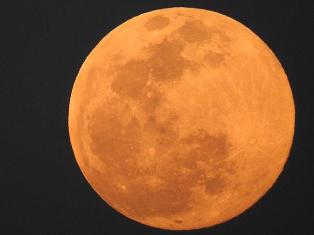

HONG KONG: Make sure you don’t fall asleep early on the Night of September 27th, 2015. Why’s that? Something outstanding is going to happen in the night sky. There will be a total eclipse of the moon which happens to be the closest Supermoon of 2015. It is the Northern Hemisphere’s Harvest moon, or full moon nearest the September equinox. It’s the Southern Hemisphere’s first full moon of spring.
September’s full moon is also called a Blood Moon because it presents an eclipse of a lunar tetrad, which occurs when there are four straight total eclipses of the moon, spaced at six lunar months (full moons). Apart.
If this isn’t enough to grasp onto, there’s more! September’s Blood Moon will be the fourth and final eclipse of the lunar tetrad, which is why this eclipse is so important.
The gory name for the ‘Blood Moon’ is comes from the reddish color tint they take on when sunrises and sunsets seen from Earth reflect onto the surface of the moon.
According to EarthSky.org, September 2015 moon will stay full all night on September 27th & 28th. Like any other full moon, the Northern Hemisphere’s Harvest Moon will shine all night long and is expected to sort the highest in the sky around midnight and will set in the west around sunrise.
Astronomers say that the moon turns full at a well-defined instant: when it’s opposite in the sun in ecliptic longitude. The instant this happens on September 28, 2015, at U.S. time zones the precise time of full moon on the night of September 27 will be at 10:51 p.m, EDT, 9:51 p.m., CDT, 8:51 p.m, MDT or 7:51 p.m. At that exact time, due to the eclipse that is happening the moon will be totally submerged in the Earth’s dark umbra shadow.
The full moon passes directly through Earth’s dark (umbra) shadow. The total part of the eclipse lasts for 72 minutes and the moon will take about 3 and 1/3 hours to completely flow through Earth’s dark shadow.

Tesla driverless system to use updated radar technology
WASHINGTON: Electric carmaker Tesla announced Sunday it was upgrading its Autopilot software to use more advanced radar technology. In a...