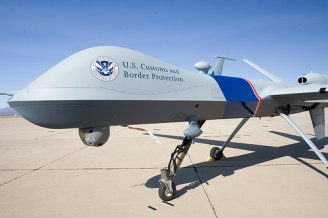
WASHINGTON: The U.S. Customs and Border Protection agency “cannot prove” that its use of Predator B drones is effective for border surveillance and should abandon its plan to expand the fleet. That is the verdict of the Department of Homeland Security (DHS) Office of Inspector General, part of the CBP’s parent organization.
In a highly critical audit report, the IG said it found “little or no evidence” that the CBP has met program expectations of increased apprehensions and reduced surveillance costs since it started using Predator Bs in 2005. The office released the audit on January 6 as a new Congress convened in Washington, D.C.


Not only has the CBP failed to develop performance metrics needed to assess the program’s effectiveness, it has substantially low-balled the cost of operating the Predators by leaving out the expense of pilots, equipment and overhead, the IG said. The CBP estimated that the program cost $2,468 per flight hour in Fiscal Year 2013 based on its maintenance and support contract, fuel and satellite communications costs. The IG calculated a cost of $12,255 per flight hour.
At the time of the audit, the CBP’s Office of Air and Marine operated 10 General Atomics-built MQ-9 Predators—five configured for surveillance over land, two Guardian maritime variants equipped with the Raytheon SeaVue surveillance radar, and three multi-role variants. They were based at Corpus Christi, Texas; Cocoa Beach, Fla., Grand Forks, N.D.; and Sierra Vista, Ariz. The agency temporarily grounded the fleet last January after a Guardian designated CBP-159 experienced a generator failure, forcing its operators to ditch it in the Pacific Ocean off San Diego.
The office also doubted the CBP’s assertion that it has no plans to acquire further Predators at this time, other than replacing the one that crashed last January. It said the agency’s long-term plan is to spend about $443 million to acquire and maintain another 14 Predators, adding to the $360 million it has spent since 2005. “CBP could put the $443 million it plans to spend to expand the program to better use by investing in alternatives, such as manned aircraft and ground surveillance assets,” the audit report states.
A press release the office issued was blunter. “Notwithstanding the significant investment, we see no evidence that the drones contribute to a more secure border, and there is no reason to invest additional taxpayer funds at this time,” said IG John Roth. “Securing our borders is a crucial mission for CBP and DHS. CBP’s drone program has so far fallen far short of being an asset to that effort.”
In a tweet, the CBP said it “disagrees with the Office of Inspector General report’s portrayal of the Unmanned Aircraft System program manad by our Office of Air and Marine, which inaccurately portrays the program’s effectiveness, and with the report’s analysis of cost and cost-per-flight-hour data.”