
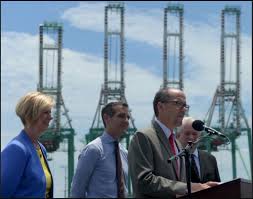
NEW YORK: U.S. Secretary of Labor Thomas E. Perez said that bills before Congress seeking to avoid lengthy negotiations marked by labor slowdowns and employer retaliation that recently plagued West Coast ports aren’t the answer. His statement poured cold water on any hopes that the Obama administration would provide support for the legislation.
“I don’t support those bills. I don’t think they are necessary,” Perez told a gathering of port-related stakeholders in Los Angeles that included the heads of the West Coast longshore union, a group representing employers, congressional representatives whose districts include the ports of Los Angeles and Long Beach and the top executives from the two largest U.S. ports.
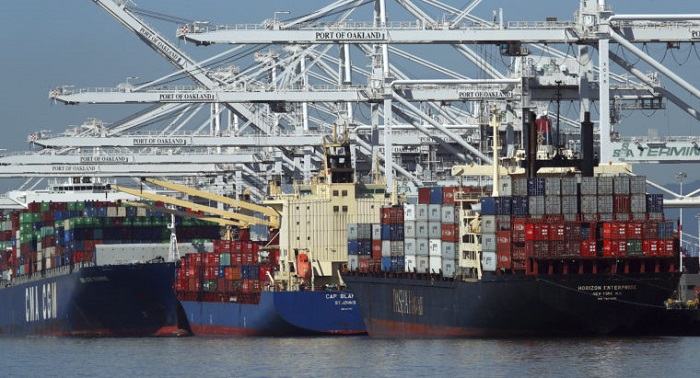

Federal law does not define a work slowdown and does not specifically prohibit maritime slowdowns, which the International Longshore and Warehouse union is accused of using in late 2014 and early 2015. The ILWU rejects accusations that it used slowdown tactics, blaming a variety of factors, including marine terminals’ inability to handle larger vessels and chassis dislocation, for the congestion that nearly crippled major West Coast container ports.
The three bills introduced in Congress all seek to change that in different ways and degrees. One bill would empower the president to intervene to halt port labor slowdowns as well as strikes, and would allow state governors to initiate the process for federal back-to-work injunctions Another bill would mandate the collection of port productivity numbers in order to provide a benchmark of normal productivity before, during and after labor negotiations. The third bill would amend the National Labor Relations Act, the law governing unionized port labor, to make intentional slowdowns by maritime unions an unfair labor practice.
Perez said the most important step Congress and the Obama administration can take is to develop port-related infrastructure that is necessary to speed the flow of cargo to and from the ports. Perez also disputed criticism that the Obama administration did not get involved early enough in the talks between the ILWU and the Pacific Maritime Association.
He said the mayors and port directors in Los Angeles and Long Beach were in frequent contact with the Obama administration after the slowdowns began began in early November and ended on Feb. 20. The president’s message that was passed on to the negotiators was, “We are agnostic on how you resolve the issues, but not on how soon.”
President Obama followed in early 2015 by sending in the federal mediator. By the time Perez arrived in San Francisco, the labor secretary said, it was first and goal and he helped to “punch it in.”
U.S. Rep. Alan Lowenthal, whose district includes the Port of Long Beach, agreed with Perez. “I don’t think we need a legislative solution,” Lowenthal said. The PMA and ILWU know each other and are used to dealing with each other, he said. However, he added that It is important for the two mayors to be engaged in the negotiating process early on and keep it from dragging on, “but not to change the process,” he said.
Like Perez, Lowenthal said the number one issue facing all ports is a lack of funding to improve and expand the port-related infrastructure that is needed to handle today’s big ships and speed imports and exports to market . “I think the central issue is efficiency and the infrastructure needed to handle the cargo,” Lowenthal said.
