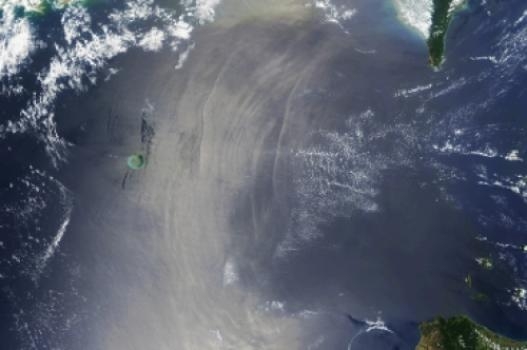

MEXICO: Two United States research yacht have teamed up to study massive undersea waves which break onto the Tasmanian continental shelf.
The waves, or internal tides, occur about 200m beneath the ocean surface and can reach 100m in height but are barely visible on the ocean’s surface.
Matthew Alford, a professor of oceanography with the Scripps Institution of Oceanography in the US, said some of the world’s most spectacular internal tides had lured about 40 of the world’s top ocean scientists to waters east of Tasmania.
“Tasmania is a special place in that it stands in the path of a powerful, focused beam of internal tidal waves generated on the Macquarie Ridge, south of New Zealand,’’ Prof Alford said.
“We have just had a full moon here, and they are on their way from NZ. It will take them about a week to come across.’’
Prof Alford arrived in Hobart this week aboard Scripps’ research vessel Roger Revelle.
Pete Strutton, a biological oceanographer with the University of Tasmania’s Institute of Marine and Antarctic Studies, will be aboard the US research vessel Falkor, operated by the Schmidt Ocean Institute, a philanthropic organisation founded by Google boss Eric Schmidt.
Associate Professor Strutton said the waves form at the boundaries between a lower layer of cool, dense water and an upper layer of warmer water.
As the waves smash against continents they cause a violent mixing of the layers, which facilitates the transfer of nutrients from the lower layer to the upper layer.
Assoc Prof Strutton said the 10-week T-TIDE project’s key goal would be to get an idea of how much mixing took place.
He said such mixing facilitated the transfer of nutrients from the ocean’s lower layers to the warm upper layers where they could be exploited by ocean food chains.

Tesla driverless system to use updated radar technology
WASHINGTON: Electric carmaker Tesla announced Sunday it was upgrading its Autopilot software to use more advanced radar technology. In a...