
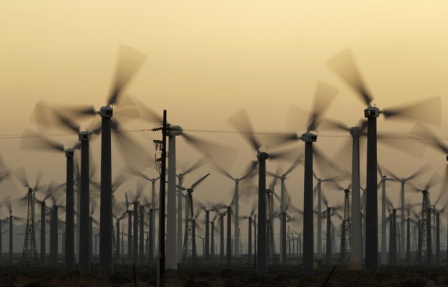


HANOI: Vietnam has a significant potential for wind energy with an average wind speed of more than 6m/s, surpassing that of all neighboring Southeast Asian countries. With more than 3,000km coastline and plenty of islands, the total potential of wind energy in Vietnam is estimated to be as high as 713,000MW – 510,000 MW on land and 203,000 MW in islands. In comparison, this is 200 times more than the production volume of the largest hydropower plant, Son La (Vietnam), in Southeast Asia and 10 times larger than the projected total capacity of the electricity industry in 2020.
Since the electricity demand in Vietnam is forecasted to increase by up to 14.2 pct. annually for the 2011-2015 period and 11.4 pct. for the 2016-2020 period , and the electricity demand is expected to increase 7 times to 800 billion Kwh in 2030, Vietnam will then have to invest in energy sources to meet this big demand. Such investment is vital given Vietnam’s expected dependence on imported coal, one of their primary resources for electricity production, by 2015. Additionally, hydroelectric energy is quite abundant in Vietnam but poses certain underlying risks. Therefore, Vietnam will have no choice for power development other than renewable energy in general and wind energy in particular.
Government’s Policy On Development Of Renewable Energy
The important role of renewable energy in general and wind energy in particular is recognized by Vietnamese government and reflected in the Master plan VII about energy development in Vietnam. The renewable energy is increasingly accounting for power sources (4.5% in 2020 and 6.0% in 2030 of the total power supply). The Master plan VII sets the renewable energy target rate at 5.6 pct. of total primary energy consumption by 2020 and 9.4 pct. by 2030. The Government’s target is to increase the wind power to 1,000 MW (0.7 pct. of electricity production) by 2020 and 6,200 MW (2.4 pct.) by 2030.
Moreover, as the energy prices in Vietnam are not very high, there are many incentives and preferential treatment offered by the Vietnamese Government to the wind power industry. Decision 37 offers the following incentives and preferential treatment in terms of funding, tax and fee to wind energy project as follows:
Funding: The investor can raise funds in different forms permitted by relevant lawsfrom individuals and organizations in and out of the country and may have access to State credit for investment pursuant to the laws.
Tariff: The investor is exempted from tariff on goods imported to create fixed assets and goods used as raw materials, input or semi-finished products that are not available at home for the project’s operation in line with the Law on Import and Export Duties , Law on Tax Mangagement and other relevant regulations on export and import duties.
iii. Corporate income tax: Wind power projects enjoy the same preferential treatment in investment in terms of exemption and reduction of corporate income tax as for other projects in line with the Law on Investment , Law on Corporate Income Tax and other documents guiding the enforcement of these laws : Perferential corporate income tax rate of 10% applies to newly-established enterprises for 15 years.

lamic banking assets reach Rs14.47 trillion, sector share rises to 23%
KARACHI: Pakistan’s Islamic banking sector expanded during 2025, increasing its share in the country’s financial system with assets reaching nearly...


