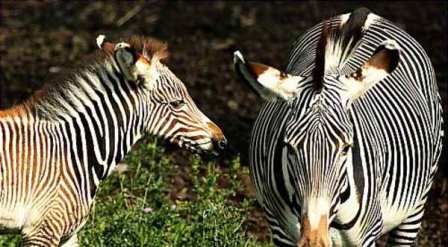
LONDON: A leopard may not be able to change its spots, but some zebras change their stripes. Zebras in warmer places have more stripes, new study shows, which might help answer an age-old question. Researchers have long been confounded as to why zebras have stripes, and now there’s a new theory that could explain their eye-catching coats.
Zebras’ thick, black stripes may have evolved to help these iconic creatures stay cool in the midday African heat, a new study suggests.


Many African animals sport some stripes on their bodies, but none of these patterns contrast as starkly as the zebra’s. Researchers have long struggled to explain the purpose of the zebra’s unique black-and-white coat. Some have suggested that the stripes may help zebras camouflage themselves and escape from lions and other predators; avoid nasty bites from disease-carrying flies; or control body heat by generating small-scale breezes over the zebra’s body when light and dark stripes heat up at different rates.
Still, few scientists have tested these explanations, and many argue that the stripes serve a complex mix of purposes
Now, researchers based at the University of California, Los Angeles (UCLA) have produced one of the most comprehensive zebra stripe studies yet by examining how 29 different environmental variables influence the stripe styles of plains zebras at 16 different sites from south to central Africa.
The scientists found that the definition of stripes along a zebra’s back most closely correlated with temperature and precipitation in a zebra’s environment, and did not correlate with the prevalence of lions or tsetse flies in the region. These findings suggest that torso stripes may do more to help zebras regulate their body temperature than to avoid predators and tsetse flies, the team reported Tuesday, Jan. 13, in the journal Royal Society Open Science.
“This wall we kept hitting up against was, ‘Well, why do zebra have to have stripes for predation? Other animals have predators, and they don’t have stripes,'” said study co-author Ren Larison, a researcher in the Department of Ecology and Evolutionary Biology at UCLA. “And other animals get bitten by flies, and they don’t have stripes, either.”