
Customs Today
  • Home
  • Islamabad
  • Karachi
  • Lahore
  • National
  • Transfers and Postings
  • Chambers & Associations
  • Business
No Result
View All Result
Customs Today
  • Home
  • Islamabad
  • Karachi
  • Lahore
  • National
  • Transfers and Postings
  • Chambers & Associations
  • Business
No Result
View All Result
Customs Today
No Result
View All Result
Home Science & Technology Science

Zebras’ stripes help them to stay cool in extreme African heat

bySana Anwar
16/01/2015
in Science, Science & Technology
Share on FacebookShare on Twitter

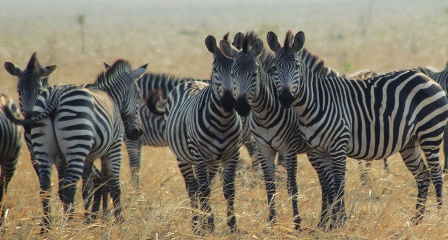
ANTARCTICA: A new study suggests that zebras’ stripes help to keep them cool in the extreme temperatures of their environment. Researchers observed that zebras living in warmer regions have more defined stripes than those found in cooler regions.

The study mentions that zebras in warmer regions of Africa are likely to have more number of stripes and thicker ones than their brethren in comparatively cooler parts.


You might also like

Tesla driverless system to use updated radar technology

12/09/2016

Apple to develop its own self-driving technology

10/09/2016

Scientists from the United States and Germany studied 29 different environmental variables in Plains zebras at 16 different locations in seven countries across south and central Africa. They also gathered data on local conditions like amount of rainfall and vegetation of the area to understand which of these factors had the most profound effect on the number of stripes on zebras and their thickness.

“Our finding that the two environmental variables most closely associated with variation in striping were both temperature variables lends support to the hypothesis that striping may be related to thermoregulation”, researchers reported.

“Zebra in areas with seasonal cold temperatures are less stripy than those in areas with sustained warm temperatures,” UCLA researcher and lead study author Brenda Larison told The Huffington Post.

Larison also went on to elaborate that these amazing striped animals have to spend more time looking for food as compared to other vegetarian animals which puts them at greater risk of overheating and falling prey to the big hunters like lions out and deadly biting insects out there in the jungle. These stripes, she says, are their defense against multiple dangers.

Another researcher Tim Caro at the University of California is not convinced. “If one were trying to cool oneself, it doesn’t seem terribly sensible to have a large expanse of black hair along your back, where the sun falls on you,” he says.

The study was funded by the National Geographic Society and its findings have been published in the journal Royal Society Open Science.


Tags: African heatBrenda Larison told The Huffington Post.Germany studiedUnited StatesZebras’ stripesZebras’ stripes help them to stay cool

Related Stories

Tesla driverless system to use updated radar technology

byCT Report
12/09/2016

WASHINGTON: Electric carmaker Tesla announced Sunday it was upgrading its Autopilot software to use more advanced radar technology. In a...

Apple to develop its own self-driving technology

byCT Report
10/09/2016

SAN FRANCISCO: Apple may not become an automaker, but it still wants to develop its own self-driving technology. The iPhone-maker's...

NASA spots slowest known magnetar

byCT Report
10/09/2016

WASHINGTON: Astronomers have found evidence of a magnetar - magnetised neutron star - that spins much slower than the slowest...

‘YouTubers’ outshining old-school television

byCT Report
09/08/2016

SAN FRANCISCO: A media revolution is taking place, and most people over 35 years of age aren’t tuned in. Millennial...

Next Post

Economic outlook revising down to 1.5%: Brazil ports to post steady growth in 2015

  • Terms and Conditions
  • Disclaimer

© 2011 Customs Today -World's first newspaper on customs. Customs Today.

No Result
View All Result
  • Transfers and Postings
  • Latest News
  • Karachi
  • Islamabad
  • Lahore
  • National
  • Chambers & Associations
  • Business
  • About Us

© 2011 Customs Today -World's first newspaper on customs. Customs Today.