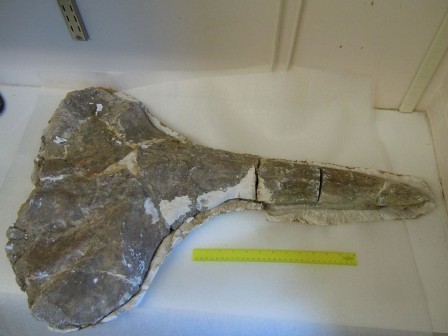


HONG KONG: Scientists left the fossil untouched for a good forty years — it was originally found in Kenya in 1964, when archaeologists misidentified it as a turtle and filed it away. But new research published this week in the Proceedings of the National Academy of Sciences says the beaked whale took a wrong turn up an African river millions of years ago, leading scientists today to new clues about how climate change determined the course of human evolution.
A team headed by Louis Jacobs, a paleontologist at Southern Methodist University in Dallas, concluded that the East African Plateau began forming no earlier than 17 million years ago, leading to the transformation of forests to grasslands, which made upright locomotion on two legs an advantageous adaptation for early human ancestors.
The fossil, found in an area likely shaped by the geological shift, may act as a beacon of sorts, helping scientists to pinpoint the exact location and date where humans began to develop into what they are today.
“It’s more or less the story about the bipedalism,” study researcher Henry Wichura told Live Science.
Scientists know that our ancient ancestors were tree dwellers. Researchers believe that the geological upheaval in East Africa, which led to a landscape with fewer trees, forced us to adapt to grasslands and walk upright.

Karachi Port sets 138-year cargo handling record
KARACHI: Pakistan's maritime sector has achieved a major milestone as Karachi Port set a new record in its 138-year history...