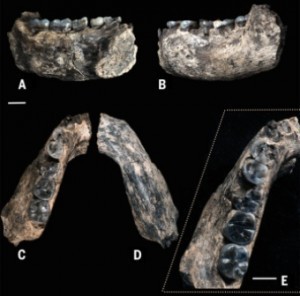


FRANCE: The newly discovered lower jawbone is about 2.8 million years old it’s just a single row of teeth, but a primitive jawbone has given archaeologists much to chew on. The fossil appears to belong to the oldest known member of the human family.
The lower jawbone, discovered in the Ethiopian Rift Valley, is approximately 400,000 years older than the earliest-known species, Homo habilis, in the lineage that led to modern humans.
For decades scientists have searched Africa for fossils that reveal insights about the origin of the Homo lineage, but specimens from this time period between 3 million and 2.5 million years ago have been noticeably absent or poorly preserved.
An international team of geologists and anthropologists have dated the new fossil, known as Ledi-Geraru after the research area where it was uncovered, to this critical interval in human evolution, between 2.8 and 2.75 million years old.
One of the team leaders Brian Villmoare said in spite of a lot of searching, fossils on the Homo lineage older than 2 million years ago are very rare.
“To have a glimpse of the very earliest phase of our lineage’s evolution is particularly exciting,” said Dr Villmoare, from the University of Nevada.
Between 3 and 2 million years ago humans made the important transition from the more ape-like Australopithecus to the more modern adaptive pattern seen in Homo.
Dr Villmoare said the Ledi-Geraru fossil was also valuable because it possessed a unique combination of traits, from the height of the mandible to the shape of the teeth, that made it clearly a species transitioning between Australopithecus and Homo.

Karachi Port sets 138-year cargo handling record
KARACHI: Pakistan's maritime sector has achieved a major milestone as Karachi Port set a new record in its 138-year history...