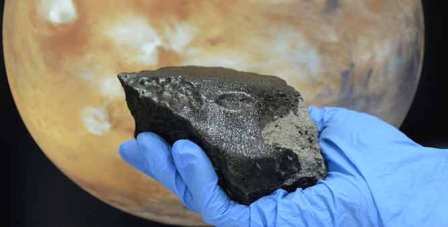
WASHINGTON: A few years ago a 4.4 billion-year-old meteorite, named as Black Beauty, was found in the Moroccan desert. Detailed study of the meteorite has revealed that is it actually a piece of Martian crust and is the first of its kind to reach Earth. The study has been published in the journal Icarus. Researchers from Brown University have mentioned that composite rocks mainly constitute the Martian landscape.
Black Beauty, formally known as NWA 7034, is a breccia, a conglomeration of different types of rocks welded together in a basaltic matrix. Scientists have found a perfect match between some of the components of the meteorite and the rock samples which have been analyzed by the Mars rover. Spectroscopic measurements of Black Beauty also match up with the orbital measurements of the dark plains of Mars. These are the regions having thin coating of red dust, due to which the crust is exposed.


Kevin Cannon, a Brown University graduate student and lead author of the new paper remarked that the meteorite represents the “bulk background” of rocks on the surface of the Red Planet. Cannon added “This is showing that if you went to Mars and picked up a chunk of crust, you’d expect it to be heavily beat up, battered, broken apart and put back together.” It has been found that Black Beauty does not resemble any other Martian meteorite found on Earth, most of which were igneous rocks composed of cooled volcanic material.
The spectral match of Black Beauty with the dark plains implies that brecciated rocks dominate this region. The research has been possible due to the new spectroscopy techniques which help the researchers to analyze samples in their entirety. Cannon stated “Other techniques give us measurements of a dime-sized spot. What we wanted to do was get an average for the entire sample. That overall measurement was what ended up matching the orbital data.”