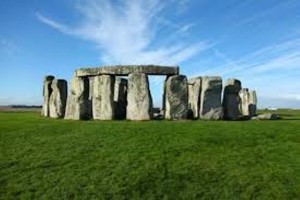
LONDON: Almost a million people a year flock to Stonehenge to marvel at the mysterious prehistoric monument, reported Huffington Post. But what if those massive bluestones were just the foundations of an enormous platform where worshippers came to perform religious ceremonies?
That’s the intriguing new theory put forth by Julian Spalding, a British art critic and former director of some of the UK’s leading museums, who says the long-lost platform would have made Stonehenge a kind of “mecca on stilts.”


“All the great raised altars of the past suggest that the people who built Stonehenge would never have performed celestial ceremonies on the lowly earth,” he told The Guardian, adding that his theory is “totally different” from any others put forward before. “That would have been unimaginably insulting to the immortal beings, for it would have brought them down from heaven to bite the dust and tread in the dung.”
Unpacking the theory. Spalding believes a round wooden platform sat atop the monument’s stones, which ancient people reached by climbing up a ramp or stairs, as he wrote in his new book Realisation. The platform would have been composed of an outer rim for pilgrims to walk around and an inner one reserved for priests and royalty, he told The Huffington Post in an email.
Last September, archaeologists discovered the monument once formed a full circle — hence the idea for the round platform.
Previous research suggested that gigantic wooden posts were set up in the area before the stones were erected. As Spalding said in the email, these posts may have been used to help erect the platform and stairway or ramps.
Spalding acknowledged that proposing the theory in the absence of physical evidence might be “a bit cheeky”. But he emphasized in the email that “nothing in the archaeological evidence contradicts my interpretation.”
What do archaeologists make of it? Dr. Aubrey Burl, a British archaeologist considered to be an expert on stone circles, told The Guardian that he thought it was worth looking into.
But others expressed skepticism. As Dr. Timothy Darvill, professor of archaeology at Bournemouth University in England and one of the recent excavators of Stonehenge, told The Huffington Post in an email:
“Some kind of superstructure for Stonehenge has been suggested many times over the last few decades, but all can be questioned on two key points. First, there is absolutely no evidence that the stones supported a timber platform or a roof of any kinds. And second, what exactly would people do up there? The stone structure we see today performs perfectly well in terms of structuring observations of the heavens at the summer and winter solstices and creating spaces for ceremonies and rituals around the use of the Bluestones.”
Stonehenge, located eight miles north of Salisbury in England and believed to have been erected 4,000 to 5,000 years ago, has been listed as a World Heritage Site since 1986.