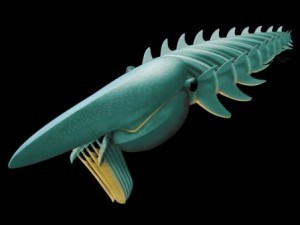
NEW YORK: Aegirocassis benmoulae, the fossil that was found in Morocco was believed to be 480 million years old. It is a sea creature and at 7 feet long, the researchers who found it believed that it could be the biggest animal creature on earth.
According to the researchers, Aegirocassis benmoulae looks like a shrimp and a lobster. It came from the palaeozoic era and it had second set of fins. This sea creature also capture its prey using its net-like appendage. It normally prey on planktons.
Aegirocassis benmoulae is an early member of the arthropod family tree and researchers believe that it was the ancestors of cockroaches, butterflies and shrimps. It could have lived in the shallow sea of Sahara Desert.
The researchers added that because of its foods, this giant sea creature was an easy going fella.
“Given the huge size of Aegirocassis and its very alien appearance, I assume most people would probably be terrified if they’d encounter it while swimming,” said Yale University paleontologist Peter Van Roy, a study author. However, contrary to almost all other anomalocaridids which were active predators, our animal would have been a very peaceful guy.”
“It is one of the biggest arthropods that ever existed, far bigger than any arthropod today,” Van Roy added.
According to Van Roy, this sea creature was part of an extinct group of animals known asanomalocaridid, which were already known to be the largest animals of the Cambrian time period 543 million to 490 million years ago. Anomalocaridids were at-bodied water dwellers, and all of them had two appendages in the front of their mouths.
“They may have come together to molt, or they may have lived in a group,” he said. “It is interesting we found so many of them. It shows there was a well-developed, rich plankton system in place 480 million years ago.”