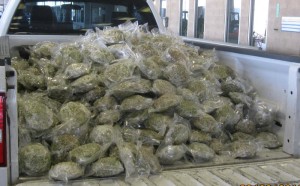
WASHINGTON: Customs officers at the Lewiston Bridge seized 55 pounds of marijuana hidden in a foosball machine last January. The street value was $60,000.
US Customs and Border Protection officers last year seized 55 pounds of marijuana hidden in a foosball table at the Lewiston Bridge crossing, according to the Department of Homeland Security.


That was just one of the many discoveries officers made along the border as customs officers recorded a 35 percent increase in narcotics confiscations, said Aaron Bowker, public affairs officer for the Buffalo Field Office of US Customs and Border Protection.
The foosball seizure made it to No. 5 of the Top 20 list of national seizures tweeted by the US Customs and Border Protection office in its year-end roundup.
The national list also included 3 pounds of meth packed in tortillas in Tucson, Ariz., and a roasted pig discovered in the luggage of a Peruvian traveler at Atlanta’s Hartsfield-Jackson International Airport.
Topping the national list of narcotics confiscations was 1.6 pounds of liquid meth found inside capillary tubing sewn into a colorful assortment of dream catchers in Columbus, Ohio.
Bowker credited a new wave of customs officers for the increase in local narcotics confiscations.
“New officers have fine-tuned their skills and are finding more illegal narcotics that are not getting into the country,” said Bowker. “It’s not necessarily the large amounts; it’s the number of seizures.”
The Buffalo Field Office, which covers 16 ports of entry in New York, made 602 narcotic seizures, an increase from fiscal year 2015 when 450 arrests were recorded, statistics revealed.
Meanwhile, efforts last year to streamline the border crossing process for commercial vehicles entering New York State resulted in an increase in truck traffic – from 943,160 in 2015 to 960,290 in 2016, reported the CBP.
“It’s a small increase, about 17,000 trucks more than last year, but we are trying to make trade more efficient,” said Bowker, who put the average crossing time for commercial border traffic at 20 minutes. Bowker said two initiatives that started in 2016 are beginning to pay off in cutting border crossing time.