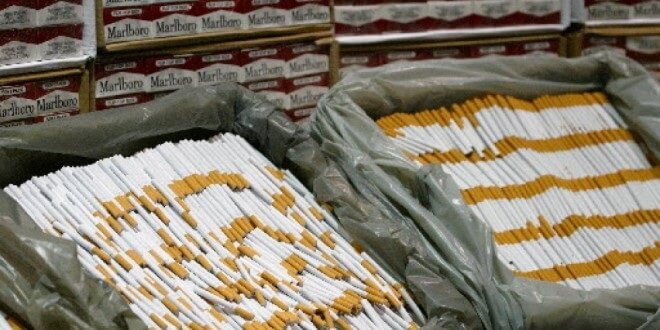
ISLAMABAD: The federal government, in coordination with provincial authorities, has launched a nationwide crackdown on the illegal cigarette trade to curb tax evasion and recover mounting revenue losses.
The initiative was announced at the launch of a research report by Oxford Economics on Pakistan’s illicit tobacco market, where Minister of State for Finance Bilal Azhar Kayani said provincial governments would intensify enforcement actions against the sale of untaxed and illegal cigarette brands.


He said controlling the illicit cigarette trade had become unavoidable, warning that it is causing heavy losses to the national exchequer, weakening the formal economy, and discouraging tax compliance. He added that several illegal manufacturing units have already been shut down, while raids against retailers involved in illicit trade are ongoing across the country.
According to the Oxford Economics report, illicit cigarettes now account for more than half of Pakistan’s tobacco market, with an estimated 43.5 billion illicit sticks circulating annually. While overall cigarette consumption has remained stable at around 80 billion sticks over the past decade, legal sales have steadily declined due to the rise of illegal products.
The report identifies sharp increases in excise duties as a key driver of this shift, noting that real excise taxes rose by 107% between Q1 2022 and Q2 2023. It further highlights a significant 64% price gap between smuggled and duty-paid cigarettes, which has encouraged a shift toward illicit consumption. The widening price difference has made illegal cigarettes significantly more attractive to consumers, contributing to the expansion of the underground market.
It also notes that the growth in illicit trade has accelerated over the last two financial years following repeated increases in tobacco duties.
Oxford Economics officials warned that sudden and steep tax hikes can distort markets and fuel illegal trade. “Pakistan’s experience shows how quickly consumption shifts when affordability and enforcement gaps widen,” said Andrew Logan, Director of Industry Consulting at Oxford Economics.
On the supply side, the report says around 64% of illicit cigarettes are produced domestically, mainly in Azad Jammu and Kashmir and Khyber Pakhtunkhwa, while the remaining 36% are smuggled through routes linked to Afghanistan, including brands associated with the UAE and South Korea. Weak enforcement, porous borders, and organized criminal networks continue to facilitate the trade.
The report also raises concerns over enforcement systems, noting that the Track and Trace System remains poorly implemented, with only 22 out of 477 brands fully compliant. It adds that illicit market share has risen from 39% to 54% since the system’s introduction. Estimated revenue losses from illegal cigarettes range between Rs274 billion and Rs343 billion, potentially exceeding total excise collections from legal sales.
Oxford Economics concluded that tackling the illicit cigarette trade requires a sustained, coordinated strategy involving predictable taxation, stronger border enforcement, retail monitoring, and full compliance with track-and-trace mechanisms.
Minister Bilal Azhar Kayani said enforcement-based tax collection had already shown positive results in improving revenue generation.
He added that the prime minister has directed all relevant federal and provincial institutions, including the Federal Board of Revenue (FBR), to jointly strengthen enforcement at production and retail levels to curb illicit trade.