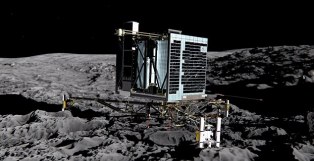


LONDON: A comet shaped like a duck has already made history for being the first to be landed on by a spacecraft. Now scientists believe the comet, known as 67P/Churyumov-Gerasimenko, could be home to life.
Leading astronomers who have been studying the findings of the European Space Agency’s Rosetta spacecraft and Philae lander believe the comet could support micro-organisms. They go as far as to suggest that the comet is more hospitable for life than our own polar regions.
They argue that the presence of such organisms is one way of explaining the comet’s “distinct and unexpected features” on its body mass, including a black crust, underlying ice, flat-bottomed craters, and a surface “peppered with mega-boulders”.
Dr Max Wallis, from the University of Cardiff, and Professor Chandra Wickramasinghe, director of the Buckingham Centre for Astrobiology, argue that the comet’s features are consistent with a mixture of ice and organic material that occur under warming from the Sun – when “active micro-organisms” can be supported.
Dr Wallis is due to present his ideas to the Royal Astronomical Society’s National Astronomy Meeting in Llandudno today. He will tell fellow scientists that the comet’s crater lakes are refrozen bodies of water covered in debris, and its large parallel furrows relate to movement on the body that generates fractures in the ice below.

Karachi Port sets 138-year cargo handling record
KARACHI: Pakistan's maritime sector has achieved a major milestone as Karachi Port set a new record in its 138-year history...