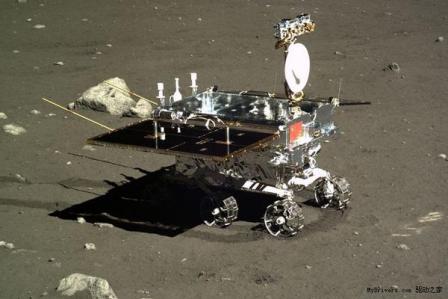
BEIJING: A preliminary result from China’s first lunar rover, Yutu, has suggested that the moon’s geological history is much more complex than previously thought.
Yutu, also known as Jade Rabbit, used ground-penetrating radar to take measurements that revealed at least nine subsurface layers beneath its landing site, indicating that multiple geologic processes once took place there.


“We have for the first time detected multiple subsurface layers (on the moon),” said lead author Xiao Long, professor of the China University of Geosciences in Wuhan, attributing these layers to ancient lava flows and the weathering of rocks and boulders into regolith, or loose layers of dust, over the past 3.3 billion years or so.
One of the most interesting findings is a layer found at the depths of 140 meters to 240 meters, said Xiao, who is also a professor of Macau University of Science and Technology.
“We think this layer is probably pyroclastic rocks which formed during the course of volcanic eruptions,” Xiao told Xinhua via email. “It reveals the diversity of volcanic activity, but what’s more important is that it shows there are plenty of volatile contents inside the moon.”
Yutu is part of China’s Chang’e-3 moon mission, which delivered a stationary lander to the lunar surface on December 14, 2013, marking the first moon landing since the Soviet Union’s Luna 24 mission in 1976.
The Yutu touched down on the northern Mare Imbrium, also known as the Sea of Rains. This regions has never before been directly sampled and it located far from the original U.S. Apollo landing sites and the landing sites of the Soviet Union’s Luna landings.