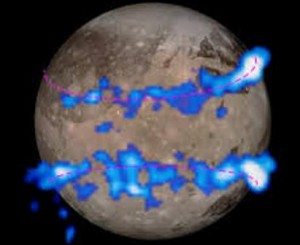


PARIS: Jupiter’s largest moon may have more water than Earth, according to new findings. Scientists who are working with the Hubble Space Telescope examined the subtle shifts of aurorae on Ganymede and determined that the moon is home to a massive subterranean ocean.
Ganymede is the largest moon in the solar system, and it’s also the only moon to have its own magnetic field. It’s the moon’s magnetic field that gives rise to aurorae. These bands of hot electrified gas circle around the north and south poles ofGanymede. Because the moon is also embedded in Jupiter’s magnetic field, the aurorae on the moon sway back and forth when the magnetic field changes.
NASA scientists are studying this swaying motion, and have concluded that saltwater must exist beneath the moon’s crust. The subterranean ocean is creating a second magnetic field and countering Jupiter’s field, creating friction. This magnetic friction is suppressingaurorae’s rocking motion to just two degrees. If no ocean were present, the aurorae’s rocking motion would be six degrees.
NASA scientist studied ultraviolet images captured by the Hubble Space Telescope to make these measurements.At the same time, they also observed the moon’s northern and southern belts. The team of scientists have four independent measurements, and all four indicate that the aurorae only moved two degrees.
What the findings show is nothing short of amazing. According to calculations, Ganymede’s ocean is 60 miles thick and buried under a 95-mile crust of ice. The ocean is ten times deeper than the oceans here on Earth.
Ganymede isn’t the first moon scientists have discovered water on.Scientists are certain that both Enceladus and Europa have oceans as well.
The Europe Space Agency will take steps to confirm these findings when they launch a probe to Jupiter in 2022. NASA is also working on a similar mission that will explore Europa.
FCCI top office-bearers set for unopposed election
FAISALABAD: The election process of the Faisalabad Chamber of Commerce & Industry (FCCI) has entered its final stage after the...