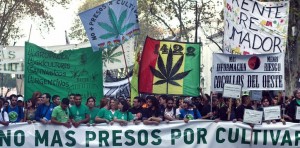
BUENOS AIRES: A passion for marijuana gripped the heart of the Argentinean capital, as over 100,000 people marched through the streets of Buenos Aires to demand legalization and the right to personal cultivation of the drug.
The demonstration marshaled around 150,000 people, the same number as in 2014, and was part of the Global Marijuana March (GMM) simultaneously celebrated in over 849 cities and 76 countries since 1999.


“We’re asking for the legalization and regularization of all cannabis, for all its uses: medical, industrial, and recreational,” Nicolás Breg, representative of the Association of Argentinean Cannabis Agriculturalists (AACA), told the PanAm Post.
The capital’s Plaza de Mayo — the location of some of the most iconic moments in Argentinean history — rapidly became a fair of all things cannabis, where entrepreneurs walked the crowds and set up stands to sell shirts, books, smoking paraphernalia, handicrafts, and food: with and without cannabis. A brisk trade in “magic” brownies that supposedly contained cannabis competed with organic food products, sandwiches, hamburgers, and the Argentinean hot dog choripán.
Police limited themselves to redirecting traffic around the march.
Police limited themselves to redirecting traffic around the march. (Ian Bulgach)
But the festive climate was tempered with a dose of activism, as the protesters installed in tents at one end of the plaza shared varied messages and information according to their group affiliation.
“No more prisoners for cultivating cannabis. Self-cultivation now!” read one AACA pamphlet, emphasizing the pain-killing and bronchodilator properties of the psychoactive.
“There’s no genuine fight against narco-trafficking or insecurity if it doesn’t begin by recognizing the complicity of security forces,” said another leaflet handed out by members of the Socialist Left party.
Despite the marijuana smoke that filled the porteño air, the federal police limited themselves to diverting traffic away from the streets. The crowds began to mobilize along the picturesque Avenida de Mayo with the national Congress as the initial destination.
Here, organizers erected a stage and several individuals spoke, including Gonzalo: an activist who told the crowd about how his medical use of marijuana helped to mitigate his illness.
Police looked the other way as protesters lit up, as if the consumption of marijuana had been legalized in the country. Argentina’s drugs law, in force since 1989, punishes “basic possession” of marijuana with a penalty of one to six years in prison, or one to two years if a judge determines that the herb is for personal consumption.
One protester holding a placard calling for “Freedom for Mary Jane” told the PanAm Post that she’d attended the march “since forever” because she believed the current law is “unjust” and Argentina “has to legalize marijuana in some form.”
“Sadly society isn’t going to permit it, if it’s not regularized by the government,” she predicted, referring to the process of legalization in Uruguay, where the state is set to assume a central role in the production and distribution of the drug.