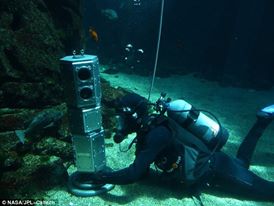


NEW YORK: It could be the rover that finds life on another planet. NASA has revealed its undersea rover has been scouring an aquarium in LA before being blasted off to Europa. There, it is hoped the small craft could scour the giant oceans to look for signs of life. Provisionally called the Buoyant Rover for Under-Ice Exploration (BRUIE), this rover would normally float and have wheels. Its wheels would roll along on the underside of ice, as if the ice were the ground. Operating underwater, the rover would take images and collect other data to help scientists understand the important interface between ice and water. For now, it was placed at the bottom of this 188,000-gallon aquatic tank, a bright orange garibaldi fish seemed to ignore a new visitor to the aquatic wonderland: the silver body of an under-ice rover. The rover’s presence 24 feet (7.3 meters) underwater at the science center this week helped researchers at NASA’s Jet Propulsion Laboratory, Pasadena, California, test the innovative rover’s systems. Andy Klesh, principal investigator for the rover at JPL and volunteer diver at the science center,said the buoyant rover can also be used here on Earth to study the Arctic and Antarctic. Researchers also envision that a technology like this could one day explore icy bodies in the solar system, and even look for signs of habitability and life. ‘A lot of what we do in deep space is applicable to the ocean,’ Klesh said. ‘This is an early prototype for vehicles that could one day go to Europa and other planetary bodies with a liquid ocean covered by ice. ‘It’s ideal for traveling under the ice shelf of an icy world.’ ‘Our work aims to build a bridge between exploring extreme environments in our own ocean and the exploration of distant, potentially habitable oceans elsewhere in the solar system,’ said Kevin Hand, co-investigator for the rover. The first iteration of this rover was a two-wheeled vehicle that the team took to Barrow, Alaska, in 2012. After the team sawed a hole in the ice, they placed the rover underwater, totally untethered. Back at JPL, engineers drove the rover remotely. ‘This was the first time an under-ice vehicle had been operated via satellite,’ Klesh said. The new version is longer, has a thicker body and is designed for ocean depths up to about 700 feet (200 meters).

Karachi Port sets 138-year cargo handling record
KARACHI: Pakistan's maritime sector has achieved a major milestone as Karachi Port set a new record in its 138-year history...