

Customs Today
  • Home
  • Islamabad
  • Karachi
  • Lahore
  • National
  • Transfers and Postings
  • Chambers & Associations
  • Business
No Result
View All Result
Customs Today
  • Home
  • Islamabad
  • Karachi
  • Lahore
  • National
  • Transfers and Postings
  • Chambers & Associations
  • Business
No Result
View All Result
Customs Today
No Result
View All Result
Home Science & Technology Science

Scientists make robot to explore deepest parts of the ocean

byCustoms Today Report
02/07/2015
in Science, Science & Technology
Share on FacebookShare on Twitter

You might also like

Tesla driverless system to use updated radar technology

12/09/2016

Apple to develop its own self-driving technology

10/09/2016

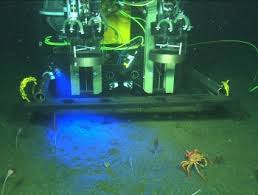
WASHINGTON: Scientists based near Oban will use custom-built robots, capable of operating at depths of seven miles, to explore the deepest parts of the ocean in a bid to discover how life is sustained there.
The research team led by Professor Ronnie N. Glud, who is based at the University of Southern Denmark, and the Scottish Association for Marine Science (SAMS) at Dunstaffnage will take the unique step of studying and sampling organisms in their own deep sea environment.
These extreme ocean regions, known as ‘hadal zones’, occur where one plate of the earth’s geological crust is sliding underneath a neighbouring plate, forming deep trenches in the seafloor.
The Hades Project requires three purpose-built robots to operate at extreme depths.
Previous expeditions led by Professor Glud, most notably to the Mariana Trench in the western Pacific Ocean the deepest part of the ocean, revealed surprisingly high levels of biological activity.
Professor Glud said: “It is extremely difficult to investigate what actually happens in the extreme deep.”
The three trenches to be visited by the researchers are in the Pacific Ocean: the Atacama Trench off Chile (max depth five miles), Japan Trench south and east of Japan (5.9 miles) and Kermadec Trench north of New Zealand (6.24 miles).
Dr Robert Turnewitsch, Principal Investigator in Marine Geochemistry at SAMS, part of the University of the Highlands and Islands, was on the team that explored the Mariana Trench and his expertise has been called upon again.

Related Stories

Tesla driverless system to use updated radar technology

byCT Report
12/09/2016

WASHINGTON: Electric carmaker Tesla announced Sunday it was upgrading its Autopilot software to use more advanced radar technology. In a...

Apple to develop its own self-driving technology

byCT Report
10/09/2016

SAN FRANCISCO: Apple may not become an automaker, but it still wants to develop its own self-driving technology. The iPhone-maker's...

NASA spots slowest known magnetar

byCT Report
10/09/2016

WASHINGTON: Astronomers have found evidence of a magnetar - magnetised neutron star - that spins much slower than the slowest...

‘YouTubers’ outshining old-school television

byCT Report
09/08/2016

SAN FRANCISCO: A media revolution is taking place, and most people over 35 years of age aren’t tuned in. Millennial...

Next Post

Massive dams pose an extinction threat to mammals, birds, tortoises

  • Terms and Conditions
  • Disclaimer

© 2011 Customs Today -World's first newspaper on customs. Customs Today.

No Result
View All Result
  • Transfers and Postings
  • Latest News
  • Karachi
  • Islamabad
  • Lahore
  • National
  • Chambers & Associations
  • Business
  • About Us

© 2011 Customs Today -World's first newspaper on customs. Customs Today.