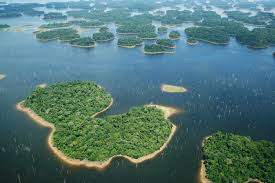


LONDON: As countries build more hydropower projects, new research warns that massive dams pose an extinction threat to mammals, birds and tortoises—at least in the Amazon.
Brazil’s Balbina Dam has turned what was once undisturbed forest into an artificial archipelago of 3,546 islands where many vertebrates have disappeared, according to a study published Wednesday by England’s University of East Anglia.
“We’re watching extinction unfold right in front of us,” says co-author Carlos Peres, a Brazilian professor at the university’s School of Environmental Sciences. “We uncovered astounding local extinction rates,” he says, even in areas that belong to a biological reserve and are protected from hunting.
The two-year study comes the same week that Brazil, in a joint U.S. announcement, pledged to restore 12 million hectares, or 46,332 square miles, of its forests—nearly the size of England—by 2030. It also promised to dramatically increase its use of solar, wind and geothermal energy. In fact, it’s planning to add floating solar panels to the Balbina Dam, located on the Uatuma River in the country’s northwestern rainforests.
Brazil currently gets most of its electricity from hydropower and like other developing countries, it plans to build hundreds of new dams to meet rising energy demand. Hydropower, often touted as “green” because of its water reuse, produces more electricity worldwide than all other renewables combined.

Karachi Port sets 138-year cargo handling record
KARACHI: Pakistan's maritime sector has achieved a major milestone as Karachi Port set a new record in its 138-year history...