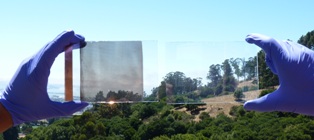


PARIS: Nanocrystal-based windows that selectively block different wavelengths of sunlight could help keep homes cool but still well lit — or warm but dark.
The technology has taken a major step toward commercialization because it blocks up to 90 percent of near-infrared and 80 percent of visible light, according to researchers at the University of Texas at Austin (UT Austin).
Controlled by voltage, the material takes minutes to switch between modes, an improvement over previous versions that took hours. And it could significantly reduce costs for heating and cooling buildings.
To optimize their windows for practical use, the researchers organized the two components of the composite material — vacancy-doped tungsten oxide nanocrystals and amorphous niobium oxide glass — to create a porous, interpenetrating network. The material is durable for at least 2000 cycles, the researchers said.
Now the team is working to produce a similarly structured nanocomposite by simple methods suitable for low-cost manufacturing.
The team also developed a single-component film made of doped titania nanocrystals that blocks visible or near-infrared light depending on voltage.
It would be most useful on a sunny winter day, when an occupant would want IR radiation to pass into a building for warmth, but glare from the sunlight would be reduced. The technology could also be used for dynamic optical filtering.

Karachi Port sets 138-year cargo handling record
KARACHI: Pakistan's maritime sector has achieved a major milestone as Karachi Port set a new record in its 138-year history...