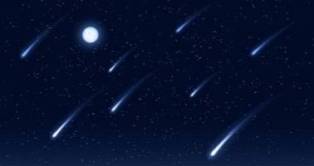


WASHINGTON: While people in the Northern Hemisphere will enjoy the stunning sight of the Perseid meteor shower, those in the South of the Equator may not be so lucky.
An almost moonless, dark sky will make this year’s shower an especially star-studded event, astronomers say.
The celestial show is expected to peak on the mornings of the 13th and 14th this month, where up to up to 100 shooting stars per hour will streak across the sky.
Stargazers will not need a telescope or special, geeky glasses. The natural fireworks display will be visible to the naked eye.
Last night’s light show was visible around the globe, but especially bright in northern latitudes above the United States, Europe and East Asia.
For most of Australia, the radiant is below the horizon, and only the very occasional meteor will be seen shooting up from the northern horizon.
The Perseid shower of “falling stars” are actually tiny bits of space rock that smash into the atmosphere at about 60 kilometres per second, burning up in flashes of light.
The flaming nuggets are a trail of dust from the comet Swift-Tuttle, which swings around the solar system every 133 years.
Occasionally, longer and brighter streaks are seen, from pea to marble-sized comet remnants.
“All comets probably have a bad case of dandruff,” said Carolin Crawford, the public astronomer at the University of Cambridge’s Institute of Astronomy.
“But this one is one where the Earth’s orbit takes it smack through the centre of the trail of debris that it leaves behind.”

Karachi Port sets 138-year cargo handling record
KARACHI: Pakistan's maritime sector has achieved a major milestone as Karachi Port set a new record in its 138-year history...