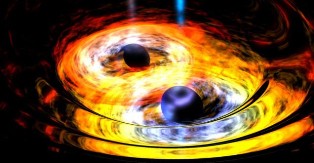


LONDON: Two supermassive black holes may be about to smash together in the constellation Virgo. Scientists have taken a look at the phenomenon and found that the pair of closely orbiting black holes is causing a rhythmic flash of light coming from the quasar PG 1302-102.
Earlier this year, astronomers discovered the black holes set on a collision course that would be so powerful that it would send a burst of gravitational waves surging through the fabric of space-time itself.
“This is the closest we’ve come to observing two black holes on their way to a massive collision,” said Zoltan Haiman, one of the researchers, in a news release. “Watching this process reach its culmination can tell us whether black holes and galaxies grow at the same rate, and ultimately test a fundamental property of space-time: its ability to carry vibrations called gravitational waves, produced in the last, most violent stage of the merger.”
At the center of most giant galaxies is a supermassive black hole that’s so dense that not even light can escape. Over time, these black holes grow bigger by gobbling up stars, galaxies, and even other black holes.
A supermassive black hole about to cannibalize another black hole can be detected by the flickering of a quasar, which is the beacon of light produced by black holes as they burn through gas and dust swirling around them. Normally, quasars brighten and dim randomly. But when two black holes approach one another, the quasar flickers at regular intervals.
In this case, the researchers built a model to explain the repeated signal and see if the black holes were as close as predicted. They found that one of the black holes was circling its much bigger counterpart at nearly a tenth of the speed of light. At this speed, the smaller black hole appears to brighten as it approaches Earth’s line of sight, under the relativistic Doppler beaming effect.

Karachi Port sets 138-year cargo handling record
KARACHI: Pakistan's maritime sector has achieved a major milestone as Karachi Port set a new record in its 138-year history...