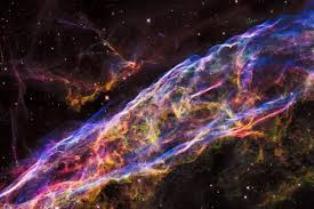


MEXICO: The Veil Nebula is part of a supernova remnant called the Cygnus Loop, which was created by the titanic explosion of a huge star 20 times the mass of our Sun.
When the star exploded 8,000 years ago it was bright enough to briefly outshine an entire galaxy.
The supernova explosion is blasting the star’s remains outwards in an ever-expanding bubble-like shell of superheated gas more than 110 light years across.
The brightest regions in this new Hubble Space Telescope image show the expanding bubble’s fast-moving blast wave edge-on as it ploughs into a wall of cool, denser interstellar gas.
The collision ionises the gas, causing it to light up in a spectacular kaleidoscope of colourful filamentary structures.
Red corresponds to the glow of hydrogen, green to sulfur, and blue to oxygen.
The bluish features, outlining the bubble wall, appear smooth and arched in comparison to the fluffy green and red structures.
The red glow is from cooler gas that was excited by the shock collision and diffused into a more chaotic appearance.
A few thin, crisp-looking, red filaments arise after gas heated to millions of degrees is swept into the shock wave at speeds of nearly 1.6 million kilometres per hour.
These wisps are all that remain of the original star.
Astronomers still are not sure of the Veil Nebula’s exact distance, with estimates ranging from 1,470 to 2,500 light-years away.
This Hubble view is a mosaic of six separate images of a small area roughly two light-years across, which, as the video below shows, covers only a tiny fraction of the nebula’s vast structure.

Karachi Port sets 138-year cargo handling record
KARACHI: Pakistan's maritime sector has achieved a major milestone as Karachi Port set a new record in its 138-year history...