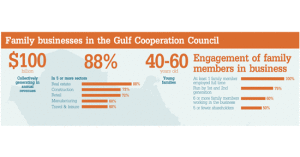
DOHA: GCC family businesses collectively generate $100bn in annual revenues across the region. Most of the businesses have diversified significantly within their home markets. Eighty eight percent of businesses are present in five or more sectors, most common being real estate, construction, retail, manufacturing, and travel and leisure, the inaugural GCC family-owned business survey conducted by McKinsey & Company has revealed.
The survey found that while family businesses have made significant progress in putting in place the governance systems, few have been successful in implementation. “We asked our participants about the presence and effectiveness of 15 practices that are key building blocks of an effective governance system. Two-thirds of the time, participants report that they have started to put the building blocks in place. However, only around one-third of the participants report that the practices are fully adopted and working effectively,” the McKinsey report said.

One of the most challenging tasks for families today is managing family dynamics, particularly when it comes to preparing the next generation and managing conflict. While 44 percent of families state that they have an employment policy in place, only 32 percent believe they have clarity on the roles and responsibilities of family members, 22 percent report that they have effective training programmes and 17 percent report that they have an effective assessment method in place for the next generation. While this is a difficult topic to address given the sensitivities, it must be tackled head-on and made a priority, especially that it is one of the most important enablers for a successful generational transition.
While all families are involved in some form of charitable giving, very few have developed organised philanthropic efforts. “All families in our sample report that they are involved in charitable giving. However, relatively few have defined a clear strategy for their giving (36 percent), established a robust governance structure to oversee their giving (20 percent), or determined how they will evaluate the impact of their efforts (16 percent). This may be in part due to the relative youth of family businesses in the region,” it said.
Over time, families may need to shed their reluctance to tap into external sources of liquidity. Today, very few family businesses in the region have public ownership at either the holding level or the subsidiary level. As the family grows, external sources of liquidity could become more important as a means of giving family members an exit and pruning the shareholding. On the business side, geographic diversification is a big priority for most family businesses. While most family groups have established some presence outside of their home countries (76 percent have some activity outside of the GCC), many have yet to make this presence meaningful.
Roughly 60 percent of family businesses still derive more than 75 percent of their revenues from their home countries. Many, however, have aspirations to expand internationally and establish regionally and globally competitive businesses; this will require family businesses to develop an exportable competitive advantage and an institution that allows them to infuse the family’s DNA in new businesses.