Customs Today
  • Home
  • Islamabad
  • Karachi
  • Lahore
  • National
  • Transfers and Postings
  • Chambers & Associations
  • Business
No Result
View All Result
Customs Today
  • Home
  • Islamabad
  • Karachi
  • Lahore
  • National
  • Transfers and Postings
  • Chambers & Associations
  • Business
No Result
View All Result
Customs Today
No Result
View All Result
Home Science & Technology Science

Hubble Space Telescope captured images of ancient white dwarf stars

byCustoms Today Report
10/11/2015
in Science, Science & Technology
Share on FacebookShare on Twitter

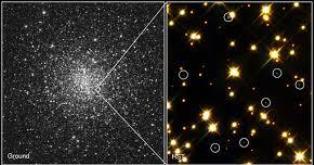
HARROW: A team of astronomers have used the Hubble Space Telescope to capture images of a mass of ancient white dwarf stars. It’s the first time the old stars have been examined, and they point to clues relating to the origins of our galaxy. The discovery is the most detailed of its kind, and is located at the core of the Milky Way.

The team was able to select 70 sample images of the white dwarfs for deeper examination. The remnants are about the size of Earth, but are 200,000 times denser. They are difficult to observe because they are minuscule.


You might also like

Tesla driverless system to use updated radar technology

12/09/2016

Apple to develop its own self-driving technology

10/09/2016

The team looked at several Hubble images of the same spot in the sky taken nine years apart. Then, they studied the stars’ movement, picking out those that lived in the core because they were slower. The region is about 26,000 light years away, and can be view clearly since there is dust-free space between it and Earth.

Then, the team began to work on identifying the dwarf stars by observing their colors, and comparing them to models that claimed that hot white dwarf stars should possess a blue tinge like younger stars do.

The information from their 70-star sample supports the claims that the Milky Way came to be early on, and the stars within it fired up during the first two billion years of existence.

Low-mass stars were also discovered in the bulge, and not in the surrounding disk. This suggests that the environment in the bulge was experienced by the later stars–located further from the core–differently during the early formation of the Milky Way. Kailash Sahu, leader of the study, said, “These 70 white dwarfs represent the peak of the iceberg. We estimate that the total number of white dwarfs is about 100,000 in this tiny Hubble view of the bulge.”


Related Stories

Tesla driverless system to use updated radar technology

byCT Report
12/09/2016

WASHINGTON: Electric carmaker Tesla announced Sunday it was upgrading its Autopilot software to use more advanced radar technology. In a...

Apple to develop its own self-driving technology

byCT Report
10/09/2016

SAN FRANCISCO: Apple may not become an automaker, but it still wants to develop its own self-driving technology. The iPhone-maker's...

NASA spots slowest known magnetar

byCT Report
10/09/2016

WASHINGTON: Astronomers have found evidence of a magnetar - magnetised neutron star - that spins much slower than the slowest...

‘YouTubers’ outshining old-school television

byCT Report
09/08/2016

SAN FRANCISCO: A media revolution is taking place, and most people over 35 years of age aren’t tuned in. Millennial...

Next Post

U.S. polished diamond imports fall 23% YOY to $1.6b in Sep 2015

  • Terms and Conditions
  • Disclaimer

© 2011 Customs Today -World's first newspaper on customs. Customs Today.

No Result
View All Result
  • Transfers and Postings
  • Latest News
  • Karachi
  • Islamabad
  • Lahore
  • National
  • Chambers & Associations
  • Business
  • About Us

© 2011 Customs Today -World's first newspaper on customs. Customs Today.