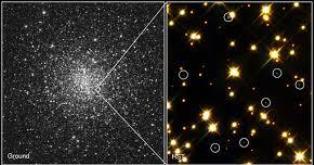
HARROW: A team of astronomers have used the Hubble Space Telescope to capture images of a mass of ancient white dwarf stars. It’s the first time the old stars have been examined, and they point to clues relating to the origins of our galaxy. The discovery is the most detailed of its kind, and is located at the core of the Milky Way.
The team was able to select 70 sample images of the white dwarfs for deeper examination. The remnants are about the size of Earth, but are 200,000 times denser. They are difficult to observe because they are minuscule.


The team looked at several Hubble images of the same spot in the sky taken nine years apart. Then, they studied the stars’ movement, picking out those that lived in the core because they were slower. The region is about 26,000 light years away, and can be view clearly since there is dust-free space between it and Earth.
Then, the team began to work on identifying the dwarf stars by observing their colors, and comparing them to models that claimed that hot white dwarf stars should possess a blue tinge like younger stars do.
The information from their 70-star sample supports the claims that the Milky Way came to be early on, and the stars within it fired up during the first two billion years of existence.
Low-mass stars were also discovered in the bulge, and not in the surrounding disk. This suggests that the environment in the bulge was experienced by the later stars–located further from the core–differently during the early formation of the Milky Way. Kailash Sahu, leader of the study, said, “These 70 white dwarfs represent the peak of the iceberg. We estimate that the total number of white dwarfs is about 100,000 in this tiny Hubble view of the bulge.”