Customs Today
  • Home
  • Islamabad
  • Karachi
  • Lahore
  • National
  • Transfers and Postings
  • Chambers & Associations
  • Business
No Result
View All Result
Customs Today
  • Home
  • Islamabad
  • Karachi
  • Lahore
  • National
  • Transfers and Postings
  • Chambers & Associations
  • Business
No Result
View All Result
Customs Today
No Result
View All Result
Home Science & Technology Science

Scientists developed a new technique to gauge the distant universe

byCT Report
05/12/2015
in Science, Science & Technology
Share on FacebookShare on Twitter

WASHINGTON: Scientists have developed a technique to use quasars – powerful sources driven by supermassive black holes at the centre of galaxies – to study the universe’s history and composition. To demonstrate the new method, based on a relation between a quasar’s luminosity at X-ray and ultraviolet wavelengths, they made extensive use of data from ESA’s XMM-Newton X-ray observatory. This approach promises to become an important tool to constrain the properties of our universe.

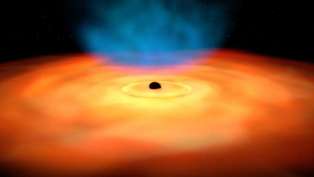
At the core of most massive galaxies in the universe is a supermassive black hole – a concentration of matter so dense that it attracts anything nearby, including light. Such black holes have masses from millions to billions of times that of the Sun and are generally idle, only accreting the occasional star or gas cloud that ventures too close to the galaxy’s centre.


You might also like

Tesla driverless system to use updated radar technology

12/09/2016

Apple to develop its own self-driving technology

10/09/2016

A small fraction of them are, however, extremely active, devouring matter at a very high rate, causing the surrounding material to shine brightly across the electromagnetic spectrum, from radio waves to X-rays and gamma rays. In some cases, emission from matter in the vicinity of the black hole is so intense that the core of the galaxy outshines the stars. These objects appear as point sources in the sky, like stars, and are known as quasars – short for quasi-stellar sources.


Related Stories

Tesla driverless system to use updated radar technology

byCT Report
12/09/2016

WASHINGTON: Electric carmaker Tesla announced Sunday it was upgrading its Autopilot software to use more advanced radar technology. In a...

Apple to develop its own self-driving technology

byCT Report
10/09/2016

SAN FRANCISCO: Apple may not become an automaker, but it still wants to develop its own self-driving technology. The iPhone-maker's...

NASA spots slowest known magnetar

byCT Report
10/09/2016

WASHINGTON: Astronomers have found evidence of a magnetar - magnetised neutron star - that spins much slower than the slowest...

‘YouTubers’ outshining old-school television

byCT Report
09/08/2016

SAN FRANCISCO: A media revolution is taking place, and most people over 35 years of age aren’t tuned in. Millennial...

Next Post

Researchers disclose secrets of Aussie 'resurrection' grass

  • Terms and Conditions
  • Disclaimer

© 2011 Customs Today -World's first newspaper on customs. Customs Today.

No Result
View All Result
  • Transfers and Postings
  • Latest News
  • Karachi
  • Islamabad
  • Lahore
  • National
  • Chambers & Associations
  • Business
  • About Us

© 2011 Customs Today -World's first newspaper on customs. Customs Today.