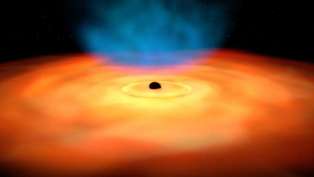
WASHINGTON: Scientists have developed a technique to use quasars – powerful sources driven by supermassive black holes at the centre of galaxies – to study the universe’s history and composition. To demonstrate the new method, based on a relation between a quasar’s luminosity at X-ray and ultraviolet wavelengths, they made extensive use of data from ESA’s XMM-Newton X-ray observatory. This approach promises to become an important tool to constrain the properties of our universe.
At the core of most massive galaxies in the universe is a supermassive black hole – a concentration of matter so dense that it attracts anything nearby, including light. Such black holes have masses from millions to billions of times that of the Sun and are generally idle, only accreting the occasional star or gas cloud that ventures too close to the galaxy’s centre.


A small fraction of them are, however, extremely active, devouring matter at a very high rate, causing the surrounding material to shine brightly across the electromagnetic spectrum, from radio waves to X-rays and gamma rays. In some cases, emission from matter in the vicinity of the black hole is so intense that the core of the galaxy outshines the stars. These objects appear as point sources in the sky, like stars, and are known as quasars – short for quasi-stellar sources.