
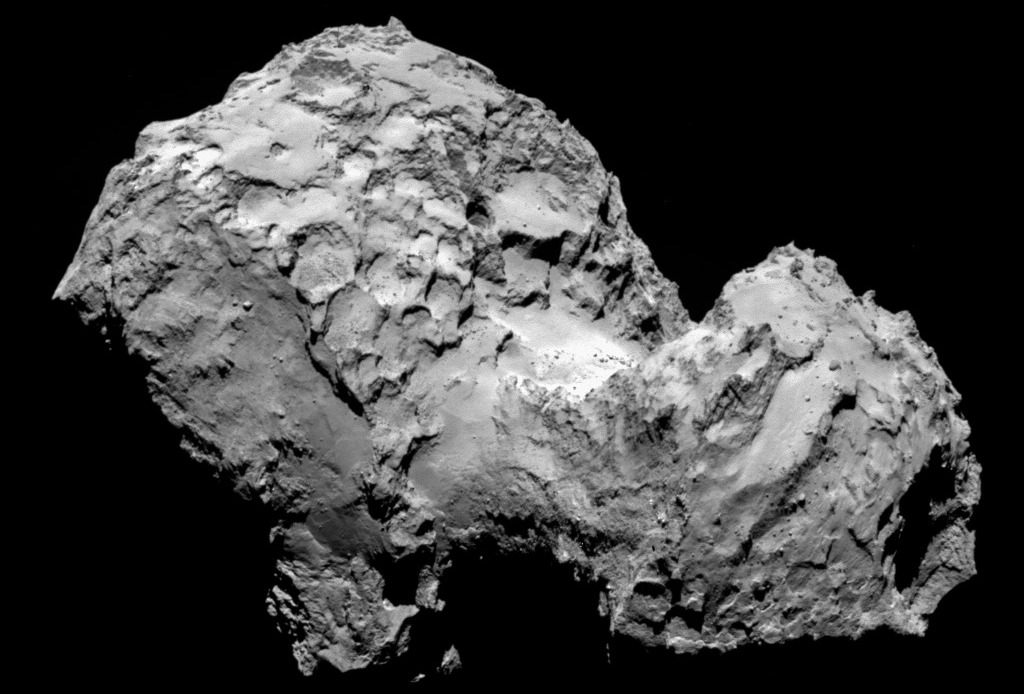
LONDON: It took more than a decade, and a looping route that roofed four billion miles, previous to a spacecraft launched by the European Space Agency wedged up with a strange comet close to Jupiter in August — and three more months before it smoothly lowered an automatic investigate to study what creates these real remnants from the early solar system moment. Last-minute malfunctions impede the skill of the probe to complete its check of surface and subsurface conditions. Even so, the mission appears to be a history-making achievement.
The spacecraft is named Rosetta, and like the stone that helped researchers decipher Egyptian hieroglyphics, scientists hope this mission will help decipher clues to the formation of the solar system 4.5 billion years ago.
The comet — known inelegantly as 67P/Churyumov-Gerasimenko — is a small, irregular glob of ice, dust and rocks less than three miles across, with a boulder-strewn surface that has only a small number of spots suitable for landing.
Rosetta has already scored two significant firsts. It is the first spacecraft to fly alongside and orbit a comet, not just fly by it, and it will stay close for more than a year to observe the comet as it goes from a quiescent state to an active emitter of gases as it draws closer to the sun. It will be the most sustained research ever conducted on one of these elusive bodies. Rosetta is also the first spacecraft to send an automated probe to the surface of a comet, allowing close study of its composition. Previous probes have landed on various planets, moons and asteroids.
Things did not go as well when the automated landing probe was lowered to the surface. The probe can’t be steered; it simply floats gently down, drawn by the minuscule gravity of the small comet. The probe was supposed to be held to the surface by reverse thrusters pressing it down and two harpoons fastening it to the surface. Neither system worked, so the probe bounced lazily twice before landing in a tilted position against a cliff with its solar panels largely shaded.
Despite the setback, the probe’s mosaic of 10 instruments was able to collect and transmit data for 57 hours before its batteries died and it went into hibernation. Scientists on the project claim they have already made important discoveries that overshadow what they consider minor glitches, though that remains to be seen. They have learned, for example, that the comet is not as soft as they expected but has a hard surface below a layer of dust.
But several experiments misfired. For instance, the shutters on an instrument meant to shoot X-rays at materials to analyze their composition failed to open, and a rod meant to measure heat flow broke when hammered into the hard surface. Meanwhile, an instrument on the spacecraft came up with readings at odds with scientific speculation that comets like this one may have bombarded Earth with enough water over the ages to fill much of the oceans.





