Customs Today
  • Home
  • Islamabad
  • Karachi
  • Lahore
  • National
  • Transfers and Postings
  • Chambers & Associations
  • Business
No Result
View All Result
Customs Today
  • Home
  • Islamabad
  • Karachi
  • Lahore
  • National
  • Transfers and Postings
  • Chambers & Associations
  • Business
No Result
View All Result
Customs Today
No Result
View All Result
Home Latest News

Scientists get first look at supermassive black hole ‘eating’ gas clouds

byCT Report
09/06/2016
in Latest News, Science
Share on FacebookShare on Twitter

SANTIAGO: Astronomers in Chile have caught the first-ever glimpse of a “supermassive” black hole preparing to gorge itself on gas clouds about a billion light years from Earth.

Using the ALMA telescope in the Atacama desert, the international team spotted three clouds streaming towards a black hole at speeds of up to 800,000 miles (1.3m km) per hour.


You might also like

SAARC chief urges turning South Asia’s challenges into opportunities

24/04/2026

DG Valuation revises import values for PVC, PU coated vide VR No.2068/2026

24/04/2026

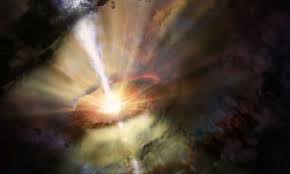
Alma telescope glimpses space’s mysteries from on top of the world. Composed mainly of carbon monoxide, the clouds were “only” 300 light years from the huge hole, “essentially teetering on the edge of being devoured, in astronomical terms”, the European Southern Observatory said in a statement on Wednesday.

The microwave-spectrum observation provides the first direct evidence for the theory that black holes feed on clouds of gas.

“It was magical being able to see evidence of these clouds accreting onto the supermassive black hole,” said Timothy Davis of Cardiff University, who took part in the research.

“This is telling us more about what [supermassive black holes] like to eat and how they evolved,” he told AFP by telephone.

Another illustration of giant gas clouds being swallowed by the black hole. The researchers cannot observe the black hole directly, inferring its presence from the motion of objects around it.

The observation was an accidental one, the teams were trying to measure how many stars are born in the galaxy when they spotted the clouds.

“We use the black hole as a backlight,” said Davis. “So, the black hole itself obviously emits no radiation but as stuff falls into the black hole that stuff is heated to very high temperatures and that material emits a lot of light.

“So what we see in this case is the shadow of the clouds as they fall into what’s the black hole … they’re between us and the black hole so they blank out some of this light.”

Black holes are very dense regions in spacetime with a gravitational force so strong that even light cannot escape it – making them invisible


Related Stories

SAARC chief urges turning South Asia’s challenges into opportunities

byCT Report
24/04/2026

ISLAMABAD: President of the SAARC Chamber of Commerce and Industry, Chandi Raj Dhakal, has emphasized that South Asia’s economic and...

DG Valuation revises import values for PVC, PU coated vide VR No.2068/2026

byCT Report
24/04/2026

KARACHI: The Directorate General of Customs Valuation has revised customs values for imports of PVC, PU and other coated fabrics...

PM clears NBP’s long-awaited Rs35 per share dividend

byCT Report
24/04/2026

ISLAMABADI: National Bank of Pakistan has received approval for its long-delayed dividend payout after Prime Minister Shehbaz Sharif cleared the...

SBP eases import financing rules for oil & LNG amid geopolitical crisis

byCT Report
24/04/2026

KARACHI: The State Bank of Pakistan (SBP) has revised key foreign exchange instructions to facilitate the import of crude oil,...

Next Post

PPC discount on electricity bills from July

  • Terms and Conditions
  • Disclaimer

© 2011 Customs Today -World's first newspaper on customs. Customs Today.

No Result
View All Result
  • Transfers and Postings
  • Latest News
  • Karachi
  • Islamabad
  • Lahore
  • National
  • Chambers & Associations
  • Business
  • About Us

© 2011 Customs Today -World's first newspaper on customs. Customs Today.