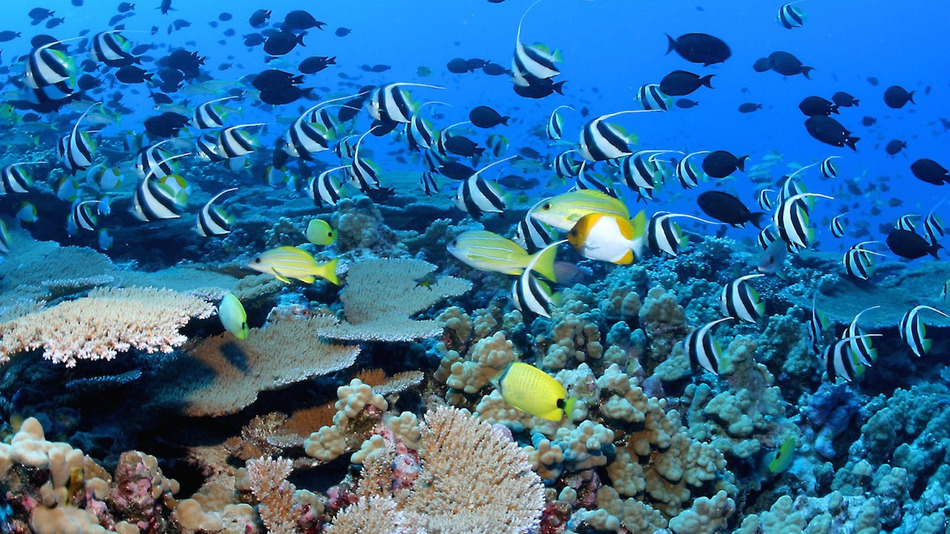


MEXICO: Corals prevailing on the Pacific island of Kiribati have revealed weather researchers that the climate climb would quickly speed up. Researchers have fractured the code of climate change through these corals and have found that the strong and weak ocean winds have a lot to say in the Earth’s climatic changes.
Scientists are of the view that the current strong winds which are known as the negative phase of the wind cycle also called as the Interdecadal Pacific Oscillation, has helped to slowdown the global warming seen over the past 15 years. However, after every two to three decades, this oscillation swings back and it is feared that a rapid increase in global warming could be on the cards when the cycle once again enters a positive phase. Diane Thompson from the National Centre for Atmospheric Research NCAR has said that increased warming was inevitable.
“When the winds are not as strong as they are today or when they weaken, which they will eventually, warming in the oceans will once again be accelerated. Then the warming caused by greenhouse gases and the warming associated with this natural cycle will work in tandem to increase the rate of Global Warming.”
It is still not clear how changes in wind govern global climate change, but there are many theories. One such suggests that the stronger winds in the Pacific force warmer waters farther into the ocean and bring cooler waters up onto the surface, which in turn cool the planet down. So it can also be said that the exact opposite happens when the wind currents are not strong enough.
A coral core sample, taken from coral growing since the 19th Century on the western front of Kiribati island had its manganese levels measured because when the easterly trade winds are weak, wind from the west blows in, and stir up manganese into the water, which is then absorbed by the coral, through which it can use grow. Another sample was taken and measured for strontium, which corresponds to temperature.

Karachi Port sets 138-year cargo handling record
KARACHI: Pakistan's maritime sector has achieved a major milestone as Karachi Port set a new record in its 138-year history...